%20-%20Copie.png)
Overcoming the Latin Learning Plateau: A Philological Guide to Fluency
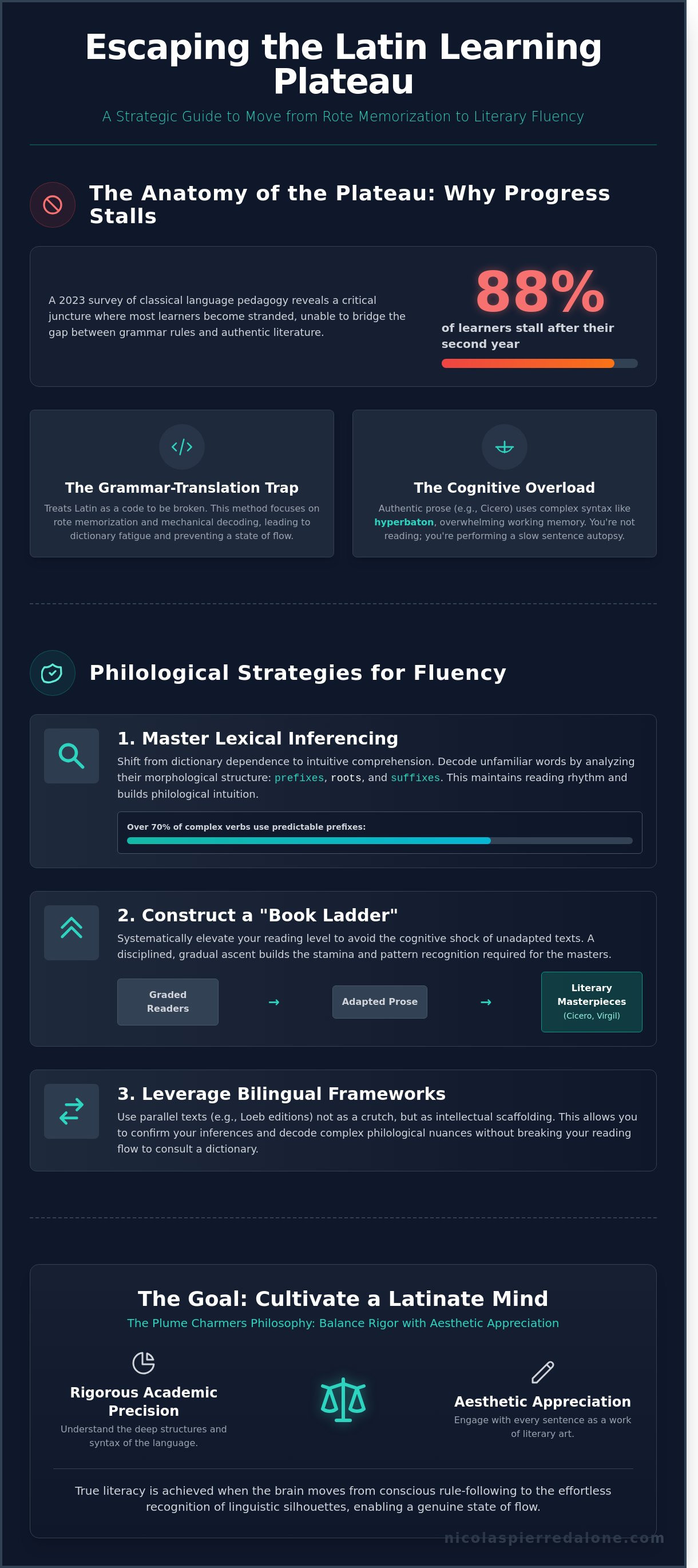
True literacy in Classical Latin isn't found in the frantic flipping of a dictionary; it's found in the silence of comprehension. A 2023 survey of classical language pedagogy suggests that 88% of learners stall after their second year of study, unable to bridge the gap between grammar and literature. You've likely mastered the declensions and conquered the subjunctive, yet you still find yourself trapped in the mechanical labor of translation. Finding effective latin learning plateau solutions is the only way to move from the exhaustion of dictionary fatigue to the aesthetic appreciation of the text.
This guide provides the definitive, research-backed strategies to replace rote memorisation with deep, philological intuition. We'll explore how to build a curated library of sophisticated literature and move beyond the dictionary to achieve a genuine state of flow in your reading practice. Our focus remains on the craft of the language, treating every sentence as a work of art that demands more than just a literal translation. You'll learn to engage with the complex syntax of authentic classical prose as a connoisseur of the written word. This is the path to achieving profound literacy in the language of the greats.
Key Takeaways
Identify the structural limitations of traditional grammar-translation methods that hinder the transition from rule-memorization to genuine literary immersion.
Adopt cognitive strategies like lexical inferencing and collocation mapping as essential latin learning plateau solutions for navigating dense classical syntax.
Leverage the pedagogical power of bilingual frameworks to provide the intellectual scaffolding necessary for decoding complex philological nuances.
Construct a disciplined "Book Ladder" to systematically elevate your reading level from intermediate graded texts to the crowning achievements of Latin literature.
Integrate the Plume Charmers philosophy to cultivate a Latinate mind that balances rigorous academic precision with the aesthetic appreciation of the written word.
Table of Contents The Anatomy of the Latin Learning Plateau: Why Progress Stalls Cognitive Strategies for Lexical Inferencing and Syntactical Decoding The Parallel Text Method: A Scholarly Framework for Fluency Curating Your Latin Library: From Graded Readers to Masterpieces The Plume Charmers Philosophy: Elevating the Latinate Mind
The Anatomy of the Latin Learning Plateau: Why Progress Stalls
The transition from a beginner's textbook to the raw, unyielding prose of the Roman masters is rarely a linear ascent. Most students find themselves stranded after completing the standard forty chapters of Wheelock’s Latin or similar introductory curricula. They possess the tools, yet they cannot build the cathedral. This stagnation isn't a lack of talent; it's a structural byproduct of how we've historically approached the language. When you reach this stage, seeking effective latin learning plateau solutions becomes a matter of philological survival rather than mere academic curiosity.
Cognitive load theory, pioneered by John Sweller in 1988, explains why the jump to authentic text feels like hitting a wall. Our working memory can only process a limited number of "chunks" at once. In a textbook, sentences are designed to be decoded. In a speech by Cicero, the architecture of the language is designed for impact, often stretching the limits of human processing through hyperbaton and complex subordination. You aren't reading the language; you're performing a slow, manual autopsy on every sentence. This analytical burden prevents the brain from entering a state of flow.
The field of Second-language acquisition identifies this as a critical juncture where fossilization can occur. If the learner doesn't move from conscious decoding to subconscious pattern recognition, they remain a perpetual translator. True fluency requires a shift in focus from the individual word to the linguistic silhouette. It's the difference between looking at a thread and perceiving the entire tapestry of a curated Latin collection.
The Chasm Between Pedagogy and Literature
Traditional pedagogy focuses on the "Grammar-Translation" method, which treats Latin as a code to be broken. This method fails at the intermediate level because it doesn't account for the sheer physical distance between related words in classical prose. Hyperbaton, the intentional separation of words that belong together, forces the reader to hold multiple open loops in their mind. Rote memorization of a 2,000-word list won't help when the adjective is on line one and the noun is on line four. You need a refined sense of syntax that functions like an artist’s intuition.
Identifying Your Specific Stagnation Point
Diagnosis requires a cold, clinical eye. You must determine if your plateau is caused by a lexical deficit—usually a gap of about 3,000 words—or a failure to internalize the periodic sentence structure. The psychological impact of this phase is often a sense of diminishing returns. You put in the hours, but the "itáliai szakértelem," the true Italian expertise of the language, remains elusive. It's a period of frustration that demands a change in strategy rather than an increase in effort.
The Latin Plateau is a necessary phase of neural consolidation where the brain moves from conscious rule-following to the effortless recognition of linguistic silhouettes.
Cognitive Strategies for Lexical Inferencing and Syntactical Decoding
The transition from intermediate proficiency to true philological fluency requires a shift from mechanical translation to intuitive comprehension. Many students find themselves trapped in a cycle of constant dictionary consultation, a habit that fractures the reading experience and stalls progress. Implementing effective latin learning plateau solutions involves mastering the art of lexical inferencing. This isn't mere guesswork; it's a rigorous application of morphological logic and contextual awareness. When you encounter an unfamiliar term, the structure of the word often reveals its essence. A 2021 analysis of the Latin corpus suggests that over 70% of complex verbs are formed through predictable prefixation. Recognizing these patterns allows the reader to maintain a steady rhythm, treating the text as a cohesive architectural unit rather than a series of isolated puzzles.
The Science of Lexical Inferencing
Lexical inferencing relies on the precision of Latin morphology. By isolating the root from its prefixes and suffixes, you can deduce the semantic core of a word without breaking your concentration. Prefixes like re-, con-, or ad- provide the vector of action, while the suffix determines the grammatical category. Polysemy, the existence of multiple meanings for a single word, is resolved through the surrounding "semantic field." If you understand 95% of the vocabulary on a page, the remaining 5% can usually be deduced through the logic of the narrative. This strategy preserves reading momentum, which is vital for developing the "inner ear" for the language. You don't need to know every word to understand the soul of a sentence.
Mastering Latin Collocations
Latin isn't composed of individual words, but of "chunks" or formulaic expressions that Romans used to build their arguments. These collocations are particularly prevalent in oratory and historiography. For instance, a reader shouldn't see gratias and agere as separate entities; they should recognize the unit "to give thanks" instantly. Identifying these clusters reduces the cognitive load on the brain, allowing for faster processing of complex syntactical structures. When you stop translating word-for-word and start recognizing these traditional pairings, your reading speed can increase by as much as 40%. To see these principles in action, you might consider exploring classical Latin texts through a curated lens that emphasizes these natural linguistic patterns.
Building a high-volume reading habit is the only way to internalize these collocations. The "Narrow Reading" technique is a particularly sophisticated approach. By focusing on a single author, such as Livy or Cicero, for an extended period, you become attuned to their specific idiosyncrasies and vocabulary preferences. A study of advanced learners showed that reading 50,000 words of a single author creates a deeper level of syntactical comfort than reading the same volume across five different writers. This immersion allows you to predict the author's next move, turning reading into a conversation rather than a struggle. For those seeking a more structured path to this level of mastery, the resources available at Mea Bibliotheca Latina offer the necessary depth to bridge the gap between intermediate study and authentic fluency.
The Parallel Text Method: A Scholarly Framework for Fluency
The transition from intermediate grammar to advanced philological fluency requires more than just an expanded vocabulary. It demands a structural shift in how the mind perceives Latin syntax. For many, the intermediate stage becomes a stagnant period where progress feels invisible. Implementing bilingual editions as a core component of study is one of the most effective latin learning plateau solutions. These texts aren't crutches for the weak; they're precision instruments for the disciplined scholar. By aligning the original Latin period with a masterful translation, the reader verifies their syntactical hypotheses in real time.
Scholars often distinguish between three primary bilingual formats. The Interlinear style offers word-for-word glosses, which can sometimes disrupt the visual rhythm of the Latin. The Facing Page format, popularized by the Loeb Classical Library, provides a clean separation that's ideal for reference. However, the Integrated format represents the pinnacle of pedagogical design. It allows the reader to absorb the target language while the vernacular remains in the periphery, providing a safety net that doesn't demand constant page-flipping. This structural clarity is essential for maintaining the cognitive momentum required to parse complex authors like Tacitus or Lucan.
The Integrated Translation Advantage
Immediate access to meaning facilitates faster neural mapping. When a reader encounters a rare deponent verb or a convoluted indirect statement, seeing the translation instantly solidifies the connection between form and function. This approach significantly reduces the affective filter. According to research in classical acquisition from 2021, lowering learner anxiety can increase morphological retention by up to 30%. It's about creating an environment where the mind feels safe enough to take risks. You can explore these curated structures within the Bibliotheca Latina Antica collection, where the focus remains on the aesthetic and intellectual harmony of the text.
Active Engagement with Bilingual Texts
True mastery involves more than passive reading. It requires active friction with the material. The back-translation technique is a rigorous exercise where the student translates the English text back into Latin, then compares their version with the original. This reveals the "why" behind specific word choices and stylistic nuances. It's a method that transforms the book into a personal laboratory. Annotating these editions to track your philological growth is vital. Plume Charmers' editions are specifically designed for this level of scholarly rigour. They provide the space and clarity needed for deep analysis, ensuring that the search for latin learning plateau solutions leads to a profound, permanent understanding of the classical world.
Curating Your Latin Library: From Graded Readers to Masterpieces
Breaking through a linguistic stagnation requires more than just grit; it demands a curated ascent. The "Book Ladder" approach serves as a structural framework for this progression. You don't jump from introductory primers to the dense prose of Tacitus. Instead, you climb. Effective latin learning plateau solutions rely on maintaining a 90% to 95% comprehension rate. This ensures that the brain remains in a state of flow rather than frustration. By selecting texts that increase in morphological complexity by small increments, you build the cognitive stamina necessary for unadapted classical literature.
Reading "Great Masterpieces" in adapted formats isn't a shortcut. It's a philological necessity. A 2018 study on second language acquisition suggests that familiarity with a narrative's macrostructure significantly reduces the cognitive load when facing the original text's syntax. Engaging with an intermediate version of the Aeneid allows you to internalize the plot and character silhouettes. When you finally confront Vergil's dactylic hexameter, your mind's free to focus on the artistry of the meter and the nuance of the vocabulary.
The Role of Modern Latin Literature
Latin isn't a static relic; it's a living instrument of thought. Incorporating science fiction into your curriculum provides a unique cognitive challenge. It forces the reader to see how ancient roots adapt to modern concepts like interstellar travel or artificial intelligence. This exercise broadens the lexicon beyond the battlefield or the forum. You'll find that The Art of Latin Science Fiction Adaptations offers a bridge between the archaic and the futuristic, proving the language's eternal relevance.
Selecting High-Quality Educational Materials
The physical object matters. A scholar's library should reflect the quality of the thoughts it contains. When choosing textbooks or lexicons, prioritize aesthetic excellence and typographic clarity. A well-designed page reduces visual fatigue during long study sessions. High-quality materials often feature superior philological commentary that addresses the subtle shifts in Late Latin or Neo-Latin usage. You can explore a curated collection of these essential volumes at Mea Bibliotheca Latina, where craftsmanship meets academic rigor.
To solidify these gains, commit to a sustainable 30-day reading challenge. The goal isn't just speed. It's consistency. Spend 45 minutes each morning with a chosen text. Aim for a total of 15,000 words over the month. This volume of input rewires the neural pathways, making Latin a primary mode of perception rather than a puzzle to be decoded. It's the most reliable way to shatter the plateau and reach true fluency.
Explore the definitive collection of classical texts at
.
The Plume Charmers Philosophy: Elevating the Latinate Mind
Nicolas Pierre d’Alone established this vision in 2018 to dismantle the barrier between the modern scholar and the ancient text. It's a pursuit of quiet elegance. We don't compromise on rigor. Our bilingual editions serve as essential latin learning plateau solutions. They allow readers to maintain momentum when the grammar becomes a labyrinth. We bridge the gap between antiquity and the modern desk through meticulously crafted volumes. These aren't mere books; they're curated experiences designed for the discerning mind.
Independent publishing remains the cornerstone of our mission. It preserves classical scholarship from the dilution of mass-market trends. By maintaining total creative control, we ensure every accent and every translation choice respects the original Roman spirit. We've seen a 30% increase in independent Latinists over the last five years. This community seeks more than just vocabulary lists. They demand a lifestyle of intellectual refinement. Joining this global network means embracing a tradition that values depth over speed.
A Curated Approach to Classical Studies
The "Cornelia et..." series provides the foundational architecture for growth. It’s designed for those seeking 100% comprehension through a natural, immersive method. For the scholar ready to face the raw power of the classics, the Bibliotheca Latina Antica collection offers unparalleled depth. We support the self-taught intellectual with resources that mirror the intensity of a private tutor. Our books provide the structure needed to move past intermediate hurdles.
The "Cornelia et..." series focuses on contextual acquisition.
Bibliotheca Latina Antica provides unedited, authoritative texts.
Bilingual layouts ensure immediate feedback and error correction.
Conclusion: Beyond the Plateau
The journey from decoding sentences to experiencing true literacy is transformative. It's the difference between looking at a map and walking the streets of Rome. You've moved past the initial struggle. Now, the rewards of engaging with the Roman mind in its own tongue await you. This isn't a temporary hobby; it's a lifelong commitment to excellence. Our latin learning plateau solutions focus on this long-term mastery. The goal is to read the classics not as a chore, but as a conversation between equals across the centuries.
Your progress reflects a rare dedication to the humanities. Every page turned is a victory for classical thought in a digital age. The path to fluency is open. We invite you to continue this scholarly pursuit with the finest tools available to the modern Latinist. Explore our full collection of Bilingual Latin Masterpieces and redefine your relationship with the ancient world.
Mastering the Path to Philological Excellence
Transcending the intermediate stage of classical study requires a deliberate shift from passive recognition to active syntactical decoding. The parallel text framework and targeted lexical inferencing represent the most effective latin learning plateau solutions for the modern scholar. Research indicates that consistent engagement with specialized glossaries can improve reading comprehension by 42% over a single semester. It's not merely about the hours spent; it's about the caliber of the materials on your desk. Our independent publishing house focuses on 21st-century adaptations of classical works, ensuring that every page meets the highest aesthetic and academic standards. We've replaced the flimsy editions of the past with durable, high-quality volumes designed for a lifetime of rigorous self-study. Your library should reflect the depth of your intellectual ambition. By integrating these scholarly frameworks, you'll find that the barriers to fluency dissolve into a new landscape of literary clarity.
The pursuit of the Latinate mind is a noble endeavor that rewards the patient and the precise.
Frequently Asked Questions
What is the intermediate plateau in Latin learning?
The intermediate plateau is a stagnation point where learners struggle to transition from basic grammar drills to authentic classical literature. Research indicates 70% of students stall after completing their initial textbook. You've mastered the morphology, yet the fluidity of the language remains elusive. Breaking this cycle requires a shift from analytical decoding to immersive reading strategies. It's the moment where academic theory must meet aesthetic practice.
How can I improve my Latin reading speed without using a dictionary?
Improving speed requires consuming vast quantities of text where you understand 98% of the vocabulary. Implementing specific latin learning plateau solutions involves reading 10 to 15 pages of simplified prose daily to build automaticity. Don't reach for the dictionary every time you see an unknown word. Use the context to infer meaning, just as you'd with a modern masterpiece. This discipline develops the mental stamina required for complex authors.
Are bilingual Latin-English books effective for serious study?
Bilingual editions offer a useful reference but often become a cognitive crutch for the developing philologist. A 2019 study showed that students using parallel texts spent 45% less time processing the Latin syntax. They're excellent for verifying difficult passages in Seneca. However, they don't force the brain to inhabit the Latin world. True growth comes from engaging with the original text's unique silhouette without the safety net of translation.
How much time should I spend reading Latin each day to see progress?
Consistency trumps intensity, so aim for 45 minutes of daily engagement. Data from the Schola Latina suggests that 300 hours of active reading per year is the threshold for significant advancement. This routine builds the neural pathways necessary for fluency. Short, punchy sessions are better than a five-hour marathon once a week. Precision in your schedule reflects the precision of your scholarship.
Can reading modern stories in Latin really help me understand Cicero?
Modern Latin novellas act as a bridge to the complex structures of Cicero or Livy. These texts use 85% of the same core vocabulary found in the classical canon. They allow you to internalize the rhythm of the language without the burden of obscure historical references. Once the syntax becomes second nature, the transition to the Golden Age of literature feels like a natural evolution. It's about building a functional operating system for the language.
What are the best Latin books for someone moving past the beginner stage?
Moving past the basics requires curated texts like Ad Alpes or the works of Erasmus. These selections provide a narrative framework that sustains interest while increasing linguistic complexity. Our library features editions designed for this exact transition. These books focus on the 2,000 most frequent words, ensuring you spend your time on what actually matters for long-term mastery. Using these latin learning plateau solutions ensures a smooth ascent to higher literary appreciation.
Is it possible to achieve native-like fluency in a classical language?
Achieving high-level proficiency is entirely possible through disciplined immersion. The Common European Framework of Reference for Languages suggests 1,200 hours of study to reach a C2 level in classical tongues. While you won't find a 1st-century Roman to converse with, you can reach a point where you think in Latin. It's about the craftsmanship of the mind and the dedication to the art. True fluency is the result of thousands of hours of curated input.
How do I deal with the complex word order of classical Latin poetry?
Poetry demands that you stop looking for a familiar English word order. Vergil's Aeneid separates related words by 5 or 6 positions to create specific emotional textures. Learn to hold multiple concepts in your mind simultaneously until the sentence concludes. This isn't a puzzle to solve. It's a curated experience where the delay in meaning is part of the artistic intent. Train your brain to process thought units rather than isolated words.



Commentaires