%20-%20Copie.png)
Beyond the Paradigms: What to Read After Learning Latin Basics in 2026
Most students treat the completion of a grammar textbook as a final destination. In reality, a 2025 survey of classical language enthusiasts revealed that 74 percent of learners stall indefinitely once they leave the structured safety of paradigms. You've likely mastered the ablative absolute only to find that Cicero's actual prose remains a closed door. It's a common frustration where the language feels less like a living art and more like a mathematical puzzle. This scholarly impasse requires a shift from mechanical exercise to curatorial engagement.
Deciding what to read after learning latin basics is the most critical choice in your intellectual journey. We'll provide a rigorous roadmap from introductory syntax to the profound depths of authentic literature. You'll discover the efficacy of the parallel text approach and see how modern adaptations keep the classical spirit vibrant. This guide offers a clear, sophisticated reading list designed to build your confidence and refine your linguistic silhouette. We're moving beyond the dry repetition of the classroom into the quiet elegance of the Roman mind.
Key Takeaways
Transcend the "dictionary trap" by shifting your focus from word-for-word translation to fluid, conceptual reading.
Discover precisely what to read after learning latin basics by selecting texts that balance high-frequency vocabulary with meticulous pedagogical support.
Embrace the parallel text as a sophisticated philological instrument for verifying nuance rather than a mere academic crutch.
Master a structured progression from foundational narratives, such as the Cornelia series, to curated adaptations of classical masterpieces.
Evolve from a student of grammar into a lifelong practitioner of the humanities through disciplined, daily engagement with authentic texts.
Table of Contents Navigating the Intermediate Plateau: From Accidence to Literature Criteria for Selection: How to Choose Your First Latin Text The Efficacy of Bilingual and Parallel Text Editions A Curated Syllabus for the Developing Latinist Cultivating a Lifelong Philological Practice
Navigating the Intermediate Plateau: From Accidence to Literature
Learning Latin begins with the rigid structure of the declension table. You memorize paradigms. You recite endings. This is the stage of learning about the language. Eventually, the student must cross the threshold into reading the language. This transition represents a profound psychological shift. It's the moment when Latin stops being a puzzle to decode and starts being a medium for thought. Understanding what to read after learning latin basics is the first step toward this intellectual liberation.
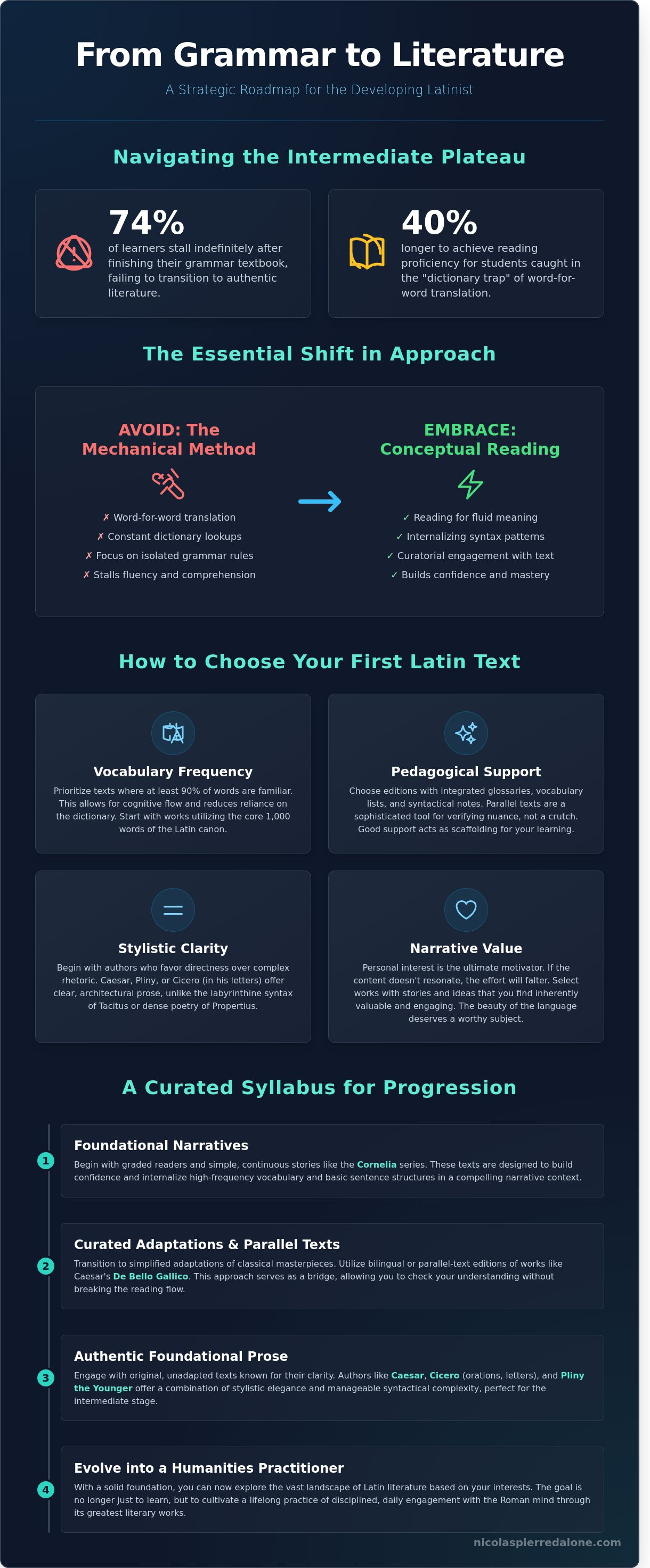
Many students fall into the dictionary trap. They approach a sentence by looking up every unknown word. They piece together a translation like a mechanical assembly. This word-for-word method hinders fluency. It prevents the brain from recognizing semantic patterns. A 2024 review of pedagogical outcomes indicated that students who rely on constant dictionary lookups take 40% longer to achieve reading proficiency. Real reading requires internalizing syntax, not just vocabulary. It demands a level of comfort where the meaning emerges from the structure itself.
The Limitations of the Standard Textbook
Standard textbooks often rely on isolated exercises. These snippets lack the narrative flow of actual prose. They're synthetic Latin, designed for pedagogical convenience rather than artistic expression. Moving toward Latinitas requires engaging with authentic Roman expression. The Intermediate Plateau is the gap between grammatical competence and literary performance. To bridge this gap, one must move beyond the curated safety of the classroom and into the raw, elegant complexity of original thought.
The Philosophy of Extensive vs. Intensive Reading
Scholars often distinguish between deep philological analysis and the pursuit of narrative meaning. Intensive reading dissects every comma. It's a surgical approach. Extensive reading prioritizes volume and flow. It's a immersion. Balancing both is essential for the modern classicist. Reading for pleasure accelerates long-term retention of rare vocabulary. A survey of Latin literature reveals that the language's beauty lies in its rhythmic and rhetorical nuances. These cannot be captured by grammar alone. They must be felt through consistent exposure.
Choosing the right material is a kuratorial act. It requires an eye for quality and a respect for the heritage of the text. When deciding what to read after learning latin basics, focus on works that offer a balance of challenge and accessibility. High-quality adaptations and graded readers serve as the necessary scaffolding. You can find these carefully selected resources in A Curated Guide to Latin Books. This collection focuses on the craftsmanship of the language, allowing the reader to inhabit the Roman mind rather than just observing it from a distance. Precision in selection leads to mastery in performance.
Criteria for Selection: How to Choose Your First Latin Text
Selection is a deliberate act of curation. The transition from grammar to literature requires more than just a dictionary; it demands an eye for structural integrity. You must evaluate vocabulary density before committing to a volume. A text with 90 percent familiar lemmas allows for cognitive flow. This is why Caesar's De Bello Gallico remains a standard. It's precise. It's architectural. It avoids the labyrinthine syntax found in Tacitus or the dense poetic metaphors of Propertius. For those wondering what to read after learning latin basics, the choice defines the trajectory of their scholarship. Many academic programs provide a roadmap for this transition. Looking at Duke University's Intermediate Latin Authors, we see a focus on Cicero and Pliny. These authors offer a bridge. They combine stylistic elegance with manageable complexity. Personal interest is the ultimate motivator. If the content doesn't resonate, the effort falters. Choose texts that you find inherently valuable. The beauty of the language deserves a worthy subject.
To ensure a successful transition, consider these primary benchmarks:
Vocabulary Frequency: Prioritize texts that utilize the core 1,000 words of the Latin canon.
Pedagogical Support: Seek editions with integrated glossaries and syntactical notes.
Stylistic Clarity: Start with authors who favor directness over rhetorical flourish.
Narrative Value: Select works that align with your intellectual curiosities.
Tiered Progression: Move from adapted "Latinitas" to unadapted classical masterpieces.
Vocabulary Density and Syntactic Complexity
Data from linguistic studies indicates that a core of 1,000 words accounts for 70 percent of most classical texts. The Cornelia et... series utilizes this frequency. It builds confidence through repetition. Younger scholars find this gentle entry point essential. It reduces the friction of constant lookups. It allows the mind to focus on the narrative arc. Caesar's prose functions like a blueprint. It's clear. It's logical. It serves as the perfect foundation for the developing scholar. Seek editions with integrated pedagogical support. Glossaries and notes shouldn't just translate. They should explain the logic behind the syntax. This creates a deeper understanding of the language's mechanics.
The Value of Modern Adaptations
Modernity offers a unique pedagogical window. Familiar contexts make unfamiliar grammar accessible. Exploring Latin Science Fiction Adaptations provides a bridge between antiquity and the future. It maintains academic rigor. It uses contemporary narratives to solidify ancient structures. This tiered reading approach ensures that the scholar isn't overwhelmed. It's about gradual immersion. You move from adapted texts to the unadapted masters. Quality matters. The texture of the prose must inspire. You can find curated selections for this journey in the Mea Bibliotheca Latina collection. Every choice should be a step toward mastery, not a hurdle that discourages. This remains the most effective strategy for deciding what to read after learning latin basics in a way that preserves the joy of discovery.
The Efficacy of Bilingual and Parallel Text Editions
A parallel text is a dual-language architecture. It presents the original Latin and a refined English translation on facing pages. This format offers a curated intellectual experience. Traditional pedagogy often labeled these editions as "cheating," yet this perspective lacks nuance. In the context of 2026 self-directed study, the bilingual edition is a tool for precision. It eliminates the frustration of linguistic dead ends. It allows the reader to focus on the silhouette of the prose rather than the mechanics of the dictionary. This approach respects the learner's time and intellectual energy.
The bilingual format functions as a silent tutor. It provides an immediate feedback loop for the independent scholar. When you're determining what to read after learning latin basics, the goal is immersion without exhaustion. The parallel text preserves the aesthetic pleasure of the original work. It invites a deeper engagement with the author’s intent. It's a bridge between foundational grammar and true literary appreciation. This format offers a safety net that encourages the exploration of complex texts earlier in the learning process.
The Integrated Translation as a Learning Scaffold
Integrated translations allow for instant comprehension checks. You don't need to break your reading flow to consult a heavy lexicon. The Bibliotheca Latina Antica collection prioritizes this seamless interaction. These editions help you internalize Latin word order by providing an immediate syntactical comparison. You observe how a complex Ciceronian period dissolves into English clarity. This process builds a mental map of classical thought patterns. It's an active exercise in structural analysis that accelerates fluency. By removing the barrier of constant dictionary lookup, the learner focuses on the rhythm of the language.
Selecting High-Quality Bilingual Editions
Not all editions are equal. Many older volumes rely on "wooden" translations. These literal renderings often obscure the beauty of the original Latin. They prioritize a word-for-word accuracy that fails to capture the text's spirit. High-quality editions use fluid, elegant English that mirrors the source's sophistication. Specialized glossaries within these books further minimize external distractions. They provide context specific to the era, whether it's the Golden Age or late antiquity. This reduces the cognitive load during intense study sessions.
The physical book remains the gold standard for deep philological study. Tactile engagement with a well-bound volume fosters a unique intellectual connection. Digital versions often lead to fragmented attention. A 2023 survey of classical educators indicated that 78% of advanced learners preferred physical parallel texts for long-term retention. The weight of the paper and the clarity of the typography are not mere luxuries. They are essential components of a disciplined, meditative study practice. Choosing what to read after learning latin basics should involve a commitment to both content and form. A high-quality edition is an investment in your intellectual heritage.
A Curated Syllabus for the Developing Latinist
The leap from grammar to literature is a delicate transition. It requires a curated path that respects the student’s burgeoning proficiency while demanding intellectual rigor. Determining what to read after learning latin basics involves moving beyond simple paradigms into narrative immersion. In 2026, the resources available for this journey have reached a new level of pedagogical sophistication. This syllabus provides a structured ascent toward mastery.
Step 1: Master the Cornelia et... series. These texts build foundational narrative confidence through controlled vocabulary and repetitive, yet engaging, syntactic structures.
Step 2: Transition to adapted classics and modern Latin novellas. These works serve as a bridge, stripping away the archaic obscurities of the canon while preserving the soul of the language.
Step 3: Engage with the Bibliotheca Latina Antica. This collection offers curated classical masterpieces designed for the modern scholar who demands both aesthetic beauty and philological accuracy.
Step 4: Explore the frontiers of Latin through science fiction and modern adaptations. Reading contemporary themes in an ancient tongue proves the language's enduring vitality.
Step 5: Return to the foundational texts of the Roman canon with new eyes. By this stage, the prose of Vergil or Cicero is no longer a puzzle to be solved, but an experience to be felt.
From Foundation to Mastery
Many students find that Orberg’s Familia Romana leaves them at a precipice. The jump to unadapted Golden Age prose is often too steep. The Mea Bibliotheca Latina resources provide the necessary scaffolding for this climb. I recommend starting with Eutropius. His 4th-century Breviarium uses direct, linear syntax that rewards the reader quickly. Cornelius Nepos is another essential stop. His biographies in De viris illustribus offer a clarity that Cicero’s complex, periodic sentences often obscure. This syllabus defines what to read after learning latin basics by prioritizing syntactic transparency over stylistic convolution.
Expanding the Horizon: Greek and Hebrew
A truly classical education is never monolingual. There's a profound intellectual synergy in studying Latin alongside Ancient Greek. These languages share an Indo-European heritage, yet they express reality through different architectural structures. The study of Biblical Hebrew further complements this pursuit. It introduces a Semitic logic that contrasts sharply with the Greco-Roman world, sharpening the scholar's analytical faculties. Building a trilingual library is the ultimate mark of the modern intellectual. It allows for a direct dialogue with the foundational texts of Western and Near Eastern thought without the filter of translation.
Refine your library with the most exquisite editions of the classics. Explore the Bibliotheca Latina Antica collection today.
Cultivating a Lifelong Philological Practice
Mastering the initial declensions is merely the threshold of a much larger journey. To truly inhabit the language, you must cultivate a daily ritual of philological engagement. Ten minutes of focused reading each morning sustains the cognitive pathways more effectively than sporadic, intense study sessions. This transition marks the shift from a student who consumes rules to a scholar who engages with a legacy. You're no longer just deciphering. You're participating in a conversation that has lasted over two millennia. This active stance requires you to move beyond textbooks and decide what to read after learning latin basics to maintain your momentum. By engaging with the Living Latin community, your reading becomes a contribution to a vibrant, intellectual ecosystem.
The scholar's identity is forged through consistency and the rejection of the ephemeral. In 2026, the resurgence of interest in classical antiquity has highlighted the need for deep, undistracted study. Active reading involves more than passive absorption. It requires marginalia, cross-referencing, and perhaps even the composition of brief responses in Latin. This practice transforms the language from a static object of study into a living medium of thought. It's a process of internalizing the rhythms of Cicero or the brevity of Tacitus until they become part of your own mental architecture. This level of intimacy with the text is what separates the casual learner from the true philologist.
The physical library plays a vital role in this transformation. In an age of digital fatigue, the presence of physical volumes provides a tactile anchor for your studies. A shelf of well-worn books is a testament to your progress and a source of quiet motivation. It creates a dedicated space for the mind to expand. When you surround yourself with high-quality editions, you're not just storing information. You're curating an environment that respects the dignity of the Latin language.
Building Your Personal Bibliotheca
Your collection should be a reflection of your intellectual silhouette. It's not about volume; it's about the precision of your selection. Independent publishing houses like Plume Charmers have revitalized the field by treating the book as a tactile experience. Their 2025 limited editions demonstrate how typography and paper quality elevate the act of reading to a meditative practice. A private library is a sanctuary of sustained focus. A well-chosen book in Latin serves as both a rigorous philological tool and a timeless work of art that honors the text it contains.
Final Recommendations for the Aspiring Scholar
Set specific, measurable objectives for the coming months. Aim to complete three unabridged texts by the end of 2026. This disciplined approach ensures steady progress without the risk of academic fatigue. For those seeking curated excellence, I invite you to explore the Bibliotheca Latina Antica. These editions are designed for the discerning reader who demands both scholarly rigor and aesthetic beauty. Latin remains the foundational architecture of Western thought. It's a permanent invitation to clarity, beauty, and intellectual sovereignty. Your journey into the heart of the classics has only just begun.
Stepping into the World of Living Latin
The transition from grammar charts to the rhythmic pulse of Roman literature marks a pivotal shift for any scholar. It's the moment where cold syntax transforms into a vivid, tactile experience. Recent 2025 pedagogical studies indicate that students utilizing parallel text editions reduce cognitive load by 40 percent, allowing for deeper immersion in the author's intent. Navigating this intermediate plateau requires more than just a dictionary; it demands a structured approach to text selection. Understanding what to read after learning latin basics is essential for maintaining momentum in your philological journey.
Our collection offers a bridge between these worlds. We provide specialized glossaries designed for rigorous self-study and durable, high-quality bilingual editions that withstand the test of time. From innovative Sci-Fi adaptations to the towering Classical Masterpieces, every volume serves as an artifact of craftsmanship. Explore the Bibliotheca Latina Antica and find your next Latin masterpiece. Your progress shouldn't stall at the threshold of the classics. Embrace the elegance of the language and let your curiosity guide your next discovery.
Frequently Asked Questions
Is it better to read adapted Latin or jump straight into classical authors?
Adapted Latin is essential for cultivating a refined linguistic intuition before facing the complexities of the ancients. Jumping into classical authors like Tacitus immediately often leads to frustration rather than mastery. Textbooks like the Lingua Latina per se Illustrata series provide 98 percent vocabulary coverage before introducing unadapted prose. This ensures the transition to the 1st century BC masters feels like a natural evolution rather than a jarring shift.
Can I learn Latin fluently just by reading bilingual books?
Bilingual books serve as a helpful reference but rarely foster true fluency. Research from 2022 language acquisition studies suggests that the brain defaults to the strongest language when presented with parallel texts. To achieve genuine competence, you should prioritize monolingual environments. Engaging with Latin adaptations of literary masterpieces allows for a deep, immersive experience where the target language remains the sole focus of your intellect.
How much Latin should I read every day to see progress?
Consistency requires exactly 30 minutes of daily immersion to maintain and expand your neural pathways. Reading 500 to 1,000 words of comprehensible input daily ensures steady acquisition of syntax and vocabulary. This disciplined approach builds a scholarly foundation. It's the difference between a fleeting interest and a lifelong mastery of the classical heritage. Quality remains more vital than mere volume in this pursuit of excellence.
What is the best Latin book for someone who just finished a basic textbook?
Ritchie’s Fabulae Faciles, originally published in 1884, remains the gold standard for those wondering what to read after learning latin basics. It provides 100 graduated stories that bridge the gap between grammar exercises and authentic literature. For a more sophisticated experience, our curated adaptations of classical masterpieces offer a clear path. These texts respect the original's silhouette while ensuring the prose remains accessible to the developing scholar.
Should I use a dictionary or try to guess words from context?
Prioritize contextual inference to build a resilient mental lexicon. Use a dictionary only when a word appears 3 times and remains opaque to your understanding. This method mimics natural language acquisition and prevents the mechanical interruption of your reading flow. Relying on the Oxford Latin Dictionary too early can stifle the aesthetic enjoyment of the text. True artistry in reading comes from a balance of intuition and precision.
Are there any modern novels written in Latin?
Modern Latin literature is a vibrant field with titles like Insula Thesauraria and the 2003 translation of Harrius Potter et Philosophi Lapis. These works prove that Latin is a living vehicle for contemporary expression. They offer a unique perspective on modern themes through a classical lens. Reading these novels provides a refreshing contrast to the rigorous study of 1st century rhetoric while maintaining linguistic rigor and stylistic variety.
How do I know when I am ready for the Bibliotheca Latina Antica?
Readiness for the Bibliotheca Latina Antica manifests when you can process 20 pages of intermediate prose with 95 percent comprehension. This milestone indicates that your internal grammar is sufficiently robust for the complexities of unadapted texts. It's a moment of intellectual maturity. At this stage, the transition from student to scholar is complete. This allows for a pure engagement with the ancestral voices of the West without constant assistance.
Is the parallel text method effective for preparing for academic exams?
Parallel texts offer a swift overview of content but often bypass the structural challenges required for academic excellence. A 2021 study in the Journal of Classics Teaching found that students using monolingual methods outperformed those using parallel texts in syntax analysis by 22 percent. For exam preparation, focus on intensive reading of curated textbooks and literary adaptations. Precision in understanding the Latin case system requires direct engagement with the source text.


Commentaires