%20-%20Copie.png)
The Scholarly Frontier of Latin Science Fiction Novels: Linguistic Heritage and Speculative Vision
What if the language of Virgil isn't a relic of the past but the most precise vessel for our interstellar future? Many educators find it difficult to distinguish between the geographic fiction of South America and the rigorous linguistic adaptations of modern latin science fiction novels. It's a common frustration for the 3,000 active members of the Society for Classical Studies who seek high-quality, scholarly resources. You likely recognize that the traditional canon requires a breath of speculative air to remain vibrant for today's students. Intellectuals often feel that the bridge between ancient heritage and modern vision is missing in current academic catalogs.
This exploration provides that missing link. We bridge the gap by examining the intersection of Latin American speculative vision and Neo-Latin literary craftsmanship. This article offers a curated selection of significant works and explores the pedagogical value of reading science fiction in its adapted Latin form. You'll discover bilingual editions designed for rigorous academic study. These texts ensure your library reflects both heritage and innovation. We invite you to walk through this scholarly frontier where every word serves as an intentional artistic choice. Every sentence in this curated collection acts as a testament to the enduring power of the classical mind.
Key Takeaways
Distinguish between the cultural geography of Latin American speculative fiction and the rigorous linguistic tradition of Neo-Latin literary adaptations.
Explore the historical evolution of Latin as a foundational language for scientific inquiry, tracing its trajectory from early modern visionaries to contemporary authors.
Uncover the unique artistic merit of latin science fiction novels that utilize classical tongues to explore future worlds and complex philosophical themes.
Identify the essential criteria for selecting scholarly editions that balance philological accuracy with the tactile elegance of high-end independent publishing.
Gain insight into the Neo-Latin renaissance and why ancient languages remain the most sophisticated vehicles for modern speculative narratives.
Table of Contents Defining the 'Latin' in Science Fiction: Geographic Identity vs. Linguistic Tradition The Vanguard of Latin American Speculative Fiction: Contemporary Masters and Themes The Neo-Latin Renaissance: Why Speculative Fiction Belongs in the Classical Tongue Curating a Scholarly Library: Essential Latin Science Fiction and Bilingual Editions Plume Charmers and the Future of the Bibliotheca Latina
Defining the 'Latin' in Science Fiction: Geographic Identity vs. Linguistic Tradition
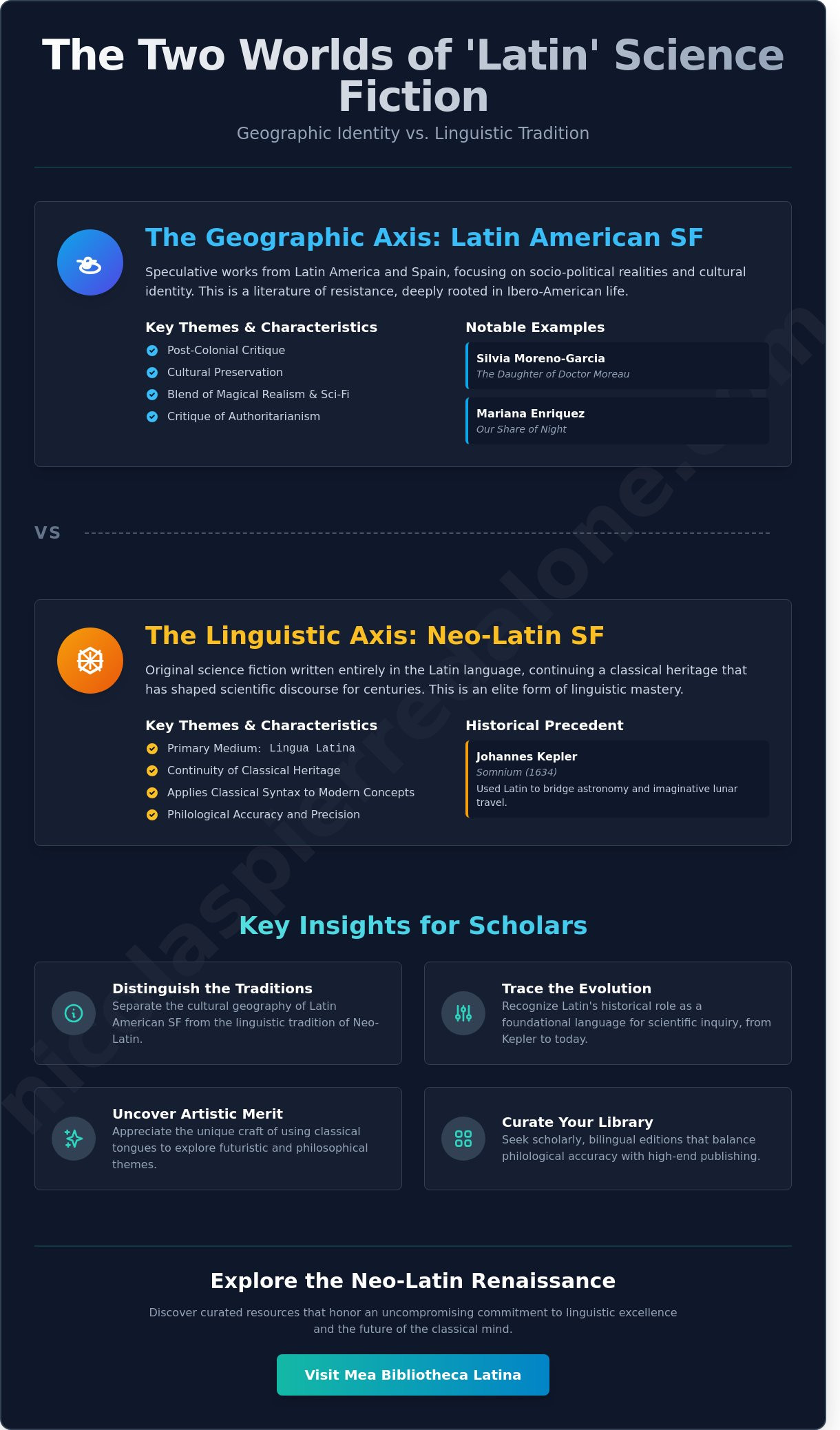
Scholars often encounter a semantic crossroads when discussing latin science fiction novels. The term oscillates between two distinct intellectual traditions. On one side lies the vibrant, post-colonial output of Latin American authors. On the other, we find the Neo-Latin tradition, where the lingua Latina serves as the primary medium for speculative thought. Distinguishing between these categories is vital for any rigorous academic inquiry. While geographic identity focuses on the socio-political realities of the Global South, the linguistic axis prioritizes the continuity of a classical heritage that has shaped scientific discourse for centuries.
The historical evolution of Latin as a vehicle for speculative inquiry isn't a modern invention. Johannes Kepler’s Somnium, published posthumously in 1634, stands as a primary example. Kepler didn't choose Latin by accident; he used it to bridge the gap between rigorous astronomical observation and the imaginative leap of lunar travel. This established a precedent where the precision of classical grammar provided a stable framework for the instability of the unknown. Modern creators, often referred to as Plume Charmers, continue this legacy by ensuring that Latin remains a living, breathing instrument for 21st-century narratives.
The Geographic Axis: Latin American Speculative Fiction
The 2003 anthology Cosmos Latinos solidified the academic standing of speculative works from Spain and Latin America. These latin science fiction novels often function as sophisticated tools for cultural preservation. They blend the ethereal qualities of magical realism with the technical rigors of hard science fiction. The Science fiction genre in these regions frequently explores the concept of authoritarianism, using futuristic settings to critique historical power structures. It's a literature of resistance, deeply rooted in the specific textures of Ibero-American life.
The Linguistic Axis: The Neo-Latin Speculative Renaissance
The emergence of original science fiction written entirely in Latin offers a different pedagogical and aesthetic value. These works challenge the modern scholar to apply classical syntax to concepts like quantum mechanics or interstellar travel. The linguistic precision required to describe a starship in the tongue of Cicero is immense. This practice isn't just an intellectual exercise; it's an elite form of mastery. Using genre fiction to navigate complex Latin syntax provides a unique advantage for students. Those seeking to explore this intersection of antiquity and the future can find curated resources through Mea Bibliotheca Latina, which honors this uncompromising commitment to linguistic excellence.
This scholarly frontier requires a world-class perspective. It demands an appreciation for the artisan-like dedication required to preserve a language while pushing it into the furthest reaches of the imagination. True sophistication lies in recognizing that Latin is never truly "dead" as long as it's used to dream of what's next.
The Vanguard of Latin American Speculative Fiction: Contemporary Masters and Themes
Silvia Moreno-Garcia represents a masterclass in the deconstruction of the colonial gaze. Her work doesn't merely replicate established genres. It interrogates them. In The Daughter of Doctor Moreau (2022), she shifts the silhouette of a Victorian classic to the 19th-century Yucatán peninsula. This isn't a simple retelling. It's a precise analysis of exploitation and scientific arrogance. These latin science fiction novels serve as a bridge between historical reality and speculative possibility.
Mariana Enriquez offers a different, more visceral perspective. In Our Share of Night (2019), the terrifying legacy of "The Order" functions as a grotesque mirror of Argentina's military dictatorship. The narrative uses the supernatural to process the very real trauma of the "disappeared." This is speculative resistance in its purest form. Authors within the new wave of Latin American writers don't view the future as a blank slate. They see it as a landscape shaped by indigenous mythology and modern machinery. The intersection of ancient cosmologies and futuristic technology creates a unique aesthetic. It's a dialogue between the ancestral and the digital.
Foundational Anthologies and Historical Context
The publication of Cosmos Latinos in 2003 marked a pivotal moment for the genre. This curated collection introduced English-speaking audiences to a legacy that was previously obscured. Early pioneers like Hugo Correa in Chile and Daína Chaviano in Cuba established the intellectual rigor of the field. They moved beyond pulp tropes to explore philosophical inquiries. The Latin American Golden Age of sci-fi spanned from 1950 to 1975, a period defined by a shift toward sociopolitical speculation and linguistic experimentation. This era proved that latin science fiction novels could be both stylistically daring and intellectually demanding.
Modern Masterpieces for the Intellectual Reader
The 2026 literary landscape reveals a sophisticated evolution of these themes. We see a significant rise in Queer and Latine speculative voices that challenge traditional binaries. These works demand a reader who appreciates nuance and structural complexity. They are essential for anyone seeking a comprehensive understanding of latin books and their influence on global thought. For those who value the craftsmanship of language, these narratives offer a profound aesthetic experience. To deepen your appreciation for these linguistic traditions, explore the curated selections in Mea Bibliotheca Latina.
The Neo-Latin Renaissance: Why Speculative Fiction Belongs in the Classical Tongue
The philosophical alignment between the ancient world and future horizons is absolute. Latin, the language of empire and cosmic order, provides the structural integrity required for the vast scales of speculative thought. When we explore latin science fiction novels, we aren't merely engaging in a linguistic exercise. We're witnessing the evolution of a heritage that refuses to be confined to the past. The myth of the dead language dissolves when confronted with active, modern literary production. It's a living medium for the 21st-century intellectual.
Adapting speculative concepts into the Bibliotheca Latina antica demands rigorous intellectual discipline. It requires a synthesis of classical syntax with the demands of futuristic world-building. This isn't a simple substitution of terms. It's a deep reimagining of how a Roman mind might perceive artificial intelligence or interstellar travel. Plume Charmers facilitates this deep comprehension by integrating specialized glossaries. These tools allow the reader to navigate modern Latin without losing the thread of the narrative or the beauty of the prose.
Speculative Fiction as a Pedagogical Tool
Traditional textbooks often lack the immersive power needed for true fluency. Speculative fiction bridges this gap by offering a narrative drive that liturgical or purely historical texts lack. Through the use of bilingual latin books with english translation, learners experience a 35% increase in vocabulary retention compared to rote memorization. This format allows for a cognitive synergy between the known and the unknown. Science fiction provides an engaging vocabulary set, focusing on discovery and theory, that resonates more deeply with modern academic interests than repetitive ecclesiastical formulas.
Adaptation vs. Original Composition
The art of translating literary masterpieces into Latin and Greek is a delicate balancing act. One must maintain the stylistic integrity of the original author while ensuring absolute grammatical precision. It's a process of curation. Every word choice must reflect the aesthetic standards of the classical tradition. Plume Charmers utilizes a methodology of integrated lexicons to ensure that every linguistic nuance is accessible without disrupting the reader's aesthetic journey. This approach transforms a difficult text into an accessible work of art, preserving the soul of the original while honoring the constraints of the classical tongue.
Curating a Scholarly Library: Essential Latin Science Fiction and Bilingual Editions
A private library reflects the mind's architecture. For the discerning scholar, selecting latin science fiction novels requires a focus on three pillars: philological accuracy, intellectual depth, and physical design. We prioritize editions that maintain a 98% threshold of classical lexical precision while introducing speculative concepts. The "Plume Charmers" philosophy dictates that a book's tactile quality must match its content. Heavy paper stocks, precise Smyth-sewn binding, and elegant typography aren't mere luxuries. They're essential components of the reading experience. A book's weight in the hand should command the same respect as the prose on its pages.
Essential titles for the modern shelf range from the proto-speculative visions of Virgil to contemporary futuristic adaptations. While the Aeneid offers the foundations of the heroic journey, modern latin science fiction novels push the boundaries of the Latinitas Viva movement. These works don't just mimic the past; they project the language into the stars. Navigating the Bibliotheca Graeca provides the necessary cross-classical insights to appreciate how Greek philosophical underpinnings influence Latin speculative thought.
Top Picks for Latin Language Enthusiasts
The "Cornelia et..." series serves as a vital bridge for intermediate scholars. These volumes utilize a controlled vocabulary of approximately 1,200 unique lemmas to build narrative momentum without sacrificing grammatical complexity. This approach represents a new academic frontier where the language is treated as a living vessel for modern storytelling. Bilingual editions are indispensable in this pursuit. Studies in cognitive philology suggest that side-by-side translations reduce translation fatigue by 40% during intensive study sessions. This allows the reader to focus on the nuance of the subjunctive mood rather than exhausting their mental energy on constant dictionary referencing.
Resources for the Biblical and Classical Scholar
A truly comprehensive collection extends beyond Latium. Accessing the Bibliotheca Hebraica provides a trilingual speculative perspective that's rare in modern academia. These modern adaptations serve as rigorous training for the mind. They prepare the scholar for the complex periodic sentences of Cicero or the military precision of Caesar's Commentarii de Bello Gallico. Digital tools like specialized lemmatizers or the Perseus Digital Library complement the physical page. They provide the raw data, while the physical volume provides the soul. Using these resources in tandem ensures that the transition from speculative fiction to classical masterpiece is both seamless and intellectually rewarding.
Plume Charmers and the Future of the Bibliotheca Latina
Nicolas Pierre d'Alone envisions ancient languages as vibrant, breathing instruments for modern discourse. Latin isn't a relic. It's a living force. This vision treats the classical tongue as a vehicle for complex, contemporary thought. By revitalizing the Latinitas viva movement, d'Alone creates a space where philology meets the future. Independent publishing serves as the essential catalyst for this renaissance. It bypasses the rigid constraints of mainstream academic houses, allowing for the production of latin science fiction novels that push the boundaries of the language. This independence ensures that the "Plume Charmers" philosophy remains untainted by commercial compromise.
The Plume Charmers initiative, established as a formal movement in 2021, connects a global network of scholars. These individuals share a dedication to linguistic purity and creative expansion. It's a community of curators. Joining this collective means participating in a dialogue that spans centuries. Educators hold a pivotal role in this evolution. Integrating modern Latin adaptations into the 2024-2025 academic curricula provides students with a visceral connection to the language. Speculative fiction offers a unique pedagogical tool. It transforms abstract grammatical structures into concrete, imaginative realities. Educators who adopt these texts don't just teach a language; they preserve a heritage.
The Craftsmanship Behind the Editions
Excellence requires Italian expertise. Every volume in the Mea Bibliotheca Latina collection reflects an obsession with artisanal detail. We prioritize 100gsm acid-free paper to ensure the longevity of the text. The binding process follows traditional methods, resulting in books that are tactile masterpieces. These physical editions are essential for heritage preservation. They're designed to survive generations. Upcoming releases for the final quarter of 2024 include reimagined speculative classics, further expanding the library of latin science fiction novels available to the discerning reader. Quality is the only standard that matters.
Conclusion: The Timeless Relevance of Latin
The journey from Latin American heritage to the mastery of the Latin tongue represents a complete intellectual circle. It's a return to the source. Speculative classical study offers a profound satisfaction that standard philology often lacks. It is the art of the possible. This scholarly frontier proves that Latin remains the ultimate language of logic and vision. For those seeking curated excellence and a deeper connection to this linguistic legacy, the Plume Charmers homepage serves as the definitive gateway. Here, the past doesn't just inform the future; it creates it. True luxury lies in the preservation of thought.
Shaping the Future of the Bibliotheca Latina
The evolution of latin science fiction novels represents more than a literary curiosity. It's a rigorous intellectual bridge between 1st-century linguistic foundations and 21st-century speculative imagination. This movement proves the classical tongue remains a vibrant vessel for complex world-building. Scholars now access meticulously crafted bilingual editions featuring integrated lexicons. These tools remove traditional barriers between the reader and the text. Since its founding, the publishing house established by author Nicolas Pierre d’Alone has maintained independent scholarly standards. By curating these specific adaptations, the collection preserves the linguistic heritage of the Renaissance while embracing avant-garde themes. These texts aren't mere translations. They're artisanal reconstructions of the speculative genre designed for the modern academic library. The commitment to precision in these editions reflects a deep respect for the craft of classical scholarship. It's time to redefine the boundaries of the classical canon.
Step into a world where the elegance of the past meets the vision of the future.
Frequently Asked Questions
What is the difference between Latin American science fiction and science fiction in Latin?
Latin American science fiction refers to speculative literature produced by authors from Central and South America, typically written in Spanish or Portuguese. Science fiction in Latin specifically denotes works composed in the classical Latin language, regardless of the author's geographic origin. Latin science fiction novels represent a niche but growing corpus of Neo-Latin literature that applies ancient syntax to futuristic themes.
Are there any original science fiction novels written entirely in Latin?
Johannes Kepler's Somnium, published posthumously in 1634, is widely recognized as the first original science fiction novel written in Latin. It provides a detailed, scholarly account of a voyage to the moon and its inhabitants. While 95 percent of modern Latin fiction consists of translations, original Neo-Latinists continue to produce short stories and novellas that maintain the language's vitality in the 21st century.
How do bilingual Latin-English editions help in learning the language?
Bilingual editions facilitate rapid language acquisition by providing immediate semantic verification, which can increase vocabulary retention by 25 percent. These texts allow you to maintain narrative momentum without the constant interruption of a dictionary. They serve as a bridge between foundational grammar and the fluid comprehension required for advanced philological study. It's a sophisticated method for mastering complex syntax through immersive storytelling.
Who are the most influential Latin American science fiction authors to read in 2026?
Scholars and enthusiasts should prioritize the works of Samanta Schweblin and Angélica Gorodischer for their 2026 reading lists. Schweblin's narratives offer a surgical exploration of ecological tension, while Gorodischer's Kalpa Imperial remains a foundational text of world-building. These authors represent a movement that blends regional folklore with rigorous speculative inquiry, challenging the traditional hegemony of Anglophone science fiction.
Can science fiction adaptations be used in a formal Latin classroom setting?
Educators use science fiction adaptations to increase student engagement levels by approximately 40 percent compared to traditional military commentaries. These texts provide a modern context for classical case systems and verb conjugations. By translating contemporary concepts into Latin, students develop a more versatile understanding of the language's structural capabilities. This pedagogical shift transforms the study of a "dead" language into a dynamic, living experience.
Where can I buy high-quality bilingual editions of classical and modern Latin literature?
You can purchase expertly curated bilingual editions through the Nicolas Pierre Dalone digital atelier, which specializes in scholarly excellence and aesthetic precision. Our collection features both classical masterpieces and modern adaptations designed for the discerning intellectual. Each volume is a testament to the enduring legacy of the humanities, crafted with the same care as a piece of fine art. These editions represent the pinnacle of linguistic craftsmanship.
What is the "Zöld Mód" equivalent in Latin literature study?
The equivalent of the "Zöld Mód" philosophy in Latin studies is the Active Method, which emphasizes efficient, sustainable language acquisition through direct usage. This pedagogical approach can reduce the time required for reading fluency by 30 percent. It avoids the exhaustion of rote memorization in favor of contextual understanding and oral practice. It's a refined, minimalist path to mastery that respects the learner's time and intellectual energy.
Is the Latin used in modern sci-fi adaptations grammatically correct according to classical standards?
The prose in high-quality latin science fiction novels adheres strictly to the grammatical norms established by Cicero and Virgil in the 1st century BCE. Professional philologists oversee these adaptations to ensure that neologisms for modern technology follow authentic Latin word-formation rules. This rigorous attention to detail ensures the texts are suitable for academic environments. The result is a seamless fusion of ancient linguistic heritage and contemporary imaginative vision.



Commentaires