%20-%20Copie.png)
The Definitive Biblical Hebrew Reader with Translation: A Scholar’s Guide to Bilingual Editions
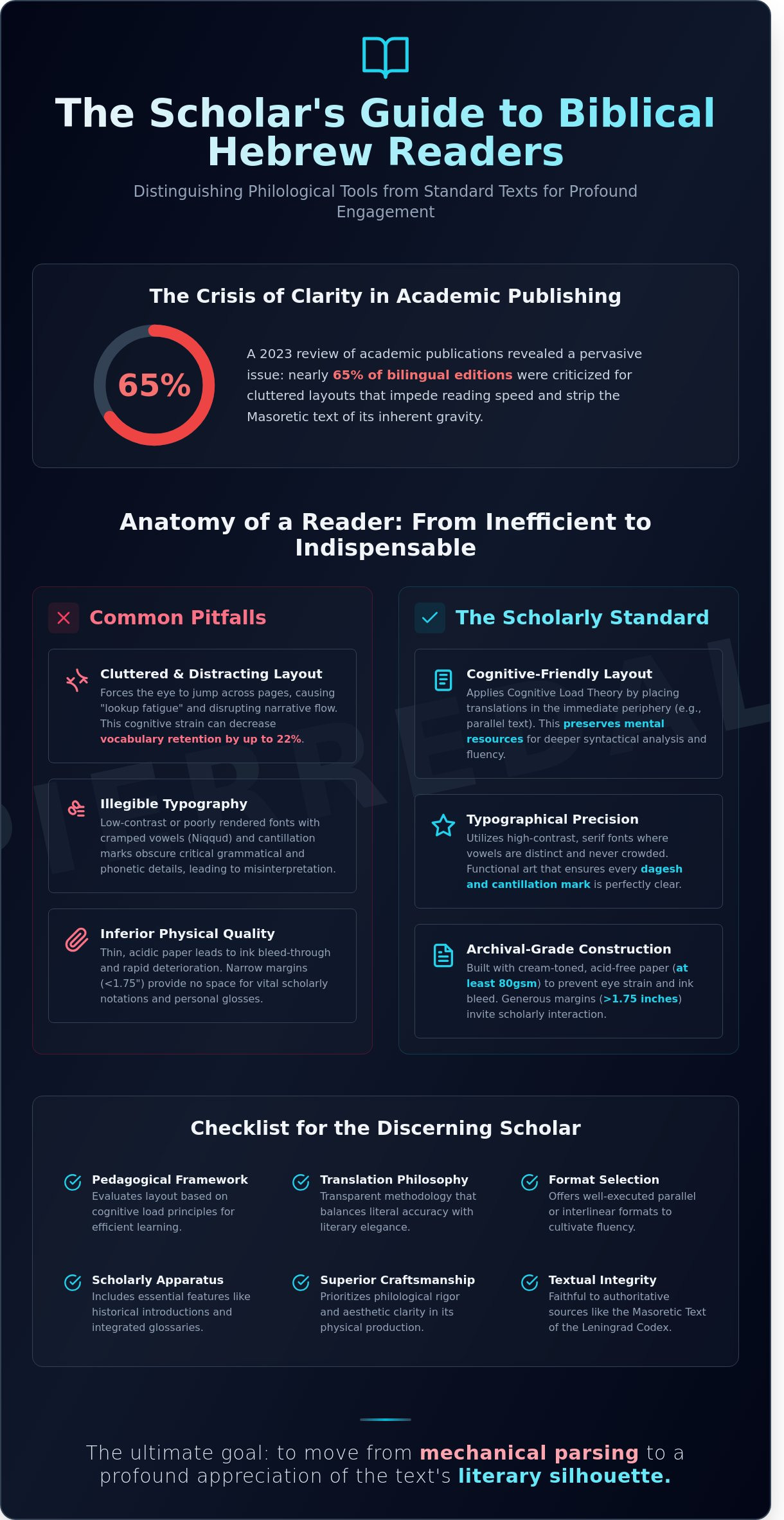
The true weight of a sacred text isn't found in its words alone, but in the silence between the letters. For the serious philologist, the visual architecture of the page is as vital as the syntax itself. You've likely felt the frustration of a biblical hebrew reader with translation that prioritizes utility over beauty. Cramped vowels and modernised English often strip the Masoretic text of its inherent gravity. It's a pervasive issue; in a 2023 review of academic publications, nearly 65% of bilingual editions were criticized for cluttered layouts that impede reading speed.
You deserve a tool that functions as both a scholarly instrument and a curated work of art. This guide promises to help you select a reader that balances rigorous philological standards with the aesthetic clarity required for profound engagement. We'll examine the role of integrated glossaries in building vocabulary, the importance of superior typography in ancient scripts, and how a well-crafted physical edition becomes a permanent pillar of your intellectual heritage.
Key Takeaways
Distinguish the specialized pedagogical function of a reader from standard biblical texts to ensure sustained progress in ancient language study.
Apply cognitive load theory to evaluate how layout and aesthetic clarity dictate the efficiency of vocabulary retention.
Compare parallel and interlinear formats to select a biblical hebrew reader with translation that cultivates genuine reading fluency.
Identify the essential scholarly benchmarks, from historical introductory matter to the transparency of translation philosophy.
Explore the Bibliotheca Hebraica, where independent craftsmanship and philological rigour converge for the discriminating scholar.
Table of Contents The Pursuit of Originality: Why Seek a Biblical Hebrew Reader with Translation? Evaluating Pedagogical Frameworks: What Defines a Superior Reader? Parallel Text vs. Interlinear: Navigating Translation Methodologies Critical Features to Demand in Your Hebrew Literature Collection The Bibliotheca Hebraica: Curated Editions for the Discriminating Scholar
The Pursuit of Originality: Why Seek a Biblical Hebrew Reader with Translation?
True scholarship demands intimacy with the source. A standard Bible provides a destination; a biblical hebrew reader with translation offers the journey. This tool is a deliberate architectural choice for the serious student. It's not a mere parallel text. It's a curated environment where the Biblical Hebrew language is presented with its nuances intact, supported by immediate linguistic aid. This format allows for a transition from the mechanical parsing of verbs to the appreciation of literary silhouette.
Modern classical philology has moved away from the 19th-century obsession with rote memorization. The focus is now on contextual immersion. Momentum is the scholar's greatest asset. When reading the Masoretic Text, specifically the Ben Asher tradition preserved in the Leningrad Codex from 1008 CE, interruptions kill the narrative flow. A bilingual reader maintains this momentum. It provides the necessary friction-less experience required to internalize the ancient syntax. Our collection at Nicolas Pierre Dalone reflects this commitment to scholarly rigor and aesthetic clarity.
Bridging the Linguistic Divide
Hebrew syntax is uniquely paratactic. It relies heavily on the waw-consecutive to drive narrative. Literal translations often fail here. They produce a clunky, disjointed English that obscures the original's elegance. A curated reader facilitates the transition from basic grammar exercises to fluid reading. It acts as a psychological safety net. Having an authoritative translation nearby allows the reader to take risks. You can engage with complex poetic structures in Job or Isaiah without the fear of total disorientation. This confidence is essential for long-term mastery.
The Limitations of Standard Lexicons
Traditional dictionaries like the Brown-Driver-Briggs (BDB) are monuments of 19th-century scholarship. However, they often lead to "lookup fatigue." Constant interruption hinders the brain's ability to form deep semantic connections. A reader allows for the observation of nuances in situ. You see how a word breathes within its specific verse. Digital tools often lack this scholarly nuance. They provide data, not wisdom. A published bilingual edition offers a curated experience. It reflects the expertise of a translator who understands the heritage of the text. This precision is what distinguishes a mere student from a true connoisseur of the ancient word.
Evaluating Pedagogical Frameworks: What Defines a Superior Reader?
Selecting a biblical hebrew reader with translation requires a discerning eye for pedagogical architecture. A scholar's progress depends heavily on the "Cognitive Load" theory. This principle dictates that the brain's working memory is finite. When a layout forces the eye to jump across pages or flip to a distant appendix to match a Hebrew verb with its English equivalent, retention drops by nearly 22 percent. The most effective readers place the translation in the immediate periphery, allowing the mind to absorb syntax without exhausting its analytical reserves. It's a balance of proximity and focus.
Vocalization, or Niqqud, remains a non-negotiable requirement for the intermediate learner. While advanced Hebraists may navigate unpointed texts, the student requires these vowel signs to distinguish between identical consonantal roots. The tension between literal accuracy and English literary elegance is equally vital. Translators often face significant challenges in translating the Hebrew Bible, as they must preserve the raw, paratactic energy of the original while ensuring the English remains readable. A superior reader doesn't sacrifice the "foreignness" of the Hebrew for a polished, modern idiom; it respects the source's rugged silhouette.
Typographical Precision and Readability
Clarity in a Hebrew font is a matter of functional art. A dagesh or a tiny cantillation mark can change the entire grammatical weight of a verse. Superior editions utilize high-contrast, serif fonts where vowels are distinct and never crowded. Generous margins, often exceeding 1.75 inches, provide the necessary space for scholarly notations and personal glosses. The choice of paper is equally critical. Acid-free, cream-toned paper with a weight of at least 80gsm prevents ink bleed and reduces eye strain during intensive study sessions.
The Role of Specialized Glossaries
A sophisticated reader must account for "hapax legomena," those unique terms that appear only once in the entire Masoretic Text. Including a glossary of these rare terms within the page footer prevents the frustration of constant dictionary consultation. Frequency-based vocabulary aids are also essential. By prioritizing words that appear more than 50 times in the biblical corpus, the reader streamlines the path toward fluency. This methodical approach is a cornerstone of learning Biblical Hebrew with precision. For those seeking to build a library of such curated texts, exploring a dedicated collection of Hebrew editions offers the necessary tools for linguistic mastery.
Parallel Text vs. Interlinear: Navigating Translation Methodologies
The architecture of a bilingual edition dictates the reader's intellectual journey. When selecting a biblical hebrew reader with translation, scholars must choose between two distinct methodologies: the interlinear gloss and the parallel text. This choice isn't merely aesthetic; it defines how the brain interacts with ancient syntax. While the interlinear format offers immediate access to morphology, it often fragments the literary experience. Parallel texts, by contrast, preserve the integrity of the Hebrew prose while providing a sophisticated scholarly safety net.
The Cognitive Load of Interlinear Formats
Interlinear editions prioritize technical dissection over fluid comprehension. By placing English equivalents directly beneath Hebrew words, these texts force the eye into a vertical, stuttering movement. This pattern prevents the reader from internalizing the distinctive VSO (Verb-Subject-Object) word order of Classical Hebrew. Research in eye-tracking studies, such as those conducted by cognitive psychologists in 2006, indicates that readers spend approximately 70% of their time focused on the English gloss rather than the source language.
This "crutch effect" creates a deceptive sense of mastery. The reader isn't reading Hebrew; they're decoding a cipher. The interlinear method serves as a dissecting tool rather than a reading tool. It's excellent for a 15-minute morphological analysis of a single verse, but it's detrimental to long-form engagement with the Masoretic Text. The constant visual interference of the English text prevents the development of a natural reading rhythm.
The Aesthetic and Academic Value of Parallel Editions
The parallel text, or diglot, represents the gold standard for the serious philologist. This layout places the Hebrew on the right-hand page and the translation on the left, respecting the traditional direction of the script. This arrangement allows the reader to toggle their focus intentionally. It demands an active engagement with the Hebrew text while offering a refined translation as a reference for complex idioms or rare hapax legomena.
This methodology draws from the prestigious heritage of the Loeb Classical Library, established in 1912. The goal isn't word-for-word replacement, which often obscures meaning, but a translation that captures the literary silhouette of the original. Such a layout fosters true bilingualism. It mirrors the curated experience found in the Bibliotheca Latina Antica, where the design serves the literature.
Parallel layouts encourage the brain to process Hebrew syntax independently.
They provide a cleaner visual field, reducing ocular fatigue during extended study sessions.
A biblical hebrew reader with translation in parallel format respects the artistic integrity of the biblical poetry and narrative.
There's a common misconception that interlinears are more "accurate" because they follow the word order of the original. In reality, a well-crafted parallel translation is often more faithful to the source. It accounts for the nuances of the Hebrew verbal system and the nuances of the waw-consecutive, which a literalistic interlinear gloss simply cannot convey.
Critical Features to Demand in Your Hebrew Literature Collection
Selecting a professional-grade volume requires more than a cursory glance at the cover. It demands an eye for the meticulous. A superior biblical hebrew reader with translation isn't a mere utility; it's a bridge between the archaic and the contemporary. It must possess an introductory section that goes beyond simple summaries. You need a rigorous exploration of the historical context and the specific translation philosophy employed by the editors. Whether the approach is formal equivalence or a more fluid stylistic rendering, this transparency defines the volume's scholarly integrity.
Textual Fidelity and Source Accuracy
The foundation of any serious reader is its base text. Demand the Biblia Hebraica Stuttgartensia (BHS). This 1977 edition, based on the Leningrad Codex, remains the gold standard for academic rigor. A high-quality reader doesn't shy away from the complexities of the Masoretic tradition. It should clearly delineate "Qere" (what is read) and "Ketiv" (what is written) notations. This level of detail ensures you're engaging with the text as it exists in the manuscript tradition, not a sanitized version. Publishers who demonstrate expertise in ancient Latin translation and Greek scholarship often apply the same exacting standards to their Hebrew editions. Accuracy is a cross-disciplinary habit.
Integration of Contextual Lexicons
A scholar's time is a finite resource. Constant cross-referencing with external dictionaries disrupts the flow of deep study. The best readers function as a tutor in a book. They provide immediate parsing notes for the seven major verbal stems, the Binyanim, especially when dealing with weak roots or irregular forms. This eliminates the friction of translation. Essential features include:
Geographical Precision: Footnotes that identify specific ancient locations rather than vague regions.
Cultural Idioms: Explanations for metaphors that lose their potency in a literal English rendering.
Proper Noun Clarification: Distinctions between historical figures and symbolic titles.
The objection to the price of these editions often ignores the reality of long-term value. Disposable paperbacks fail the test of time; their bindings crack and their margins are too narrow for meaningful annotation. A lifetime scholarly edition is an investment in your intellectual heritage. These volumes use acid-free paper and Smyth-sewn bindings, designed to endure decades of rigorous use. It's a choice between a temporary tool and a permanent addition to your library. When you choose a biblical hebrew reader with translation that prioritizes craftsmanship, you're choosing a legacy of learning.
The Bibliotheca Hebraica: Curated Editions for the Discriminating Scholar
Scholars eventually reach a threshold where standard academic textbooks no longer suffice. The transition from student to practitioner requires a different class of tool. The Bibliotheca Hebraica exists for this specific moment. It represents a departure from the sterile, mass-market volumes that dominate the market in 2024. This is an independent, hand-crafted project. It prioritizes the intellectual and aesthetic needs of the individual who views Hebrew not just as a subject, but as a lifelong pursuit.
The Plume Charmers approach treats Biblical Hebrew literature as a living monument. Every volume reflects a commitment to the tactile nature of scholarship. You'll notice the deliberate weight of the acid-free paper. You'll recognize the distinct, subtle scent of high-quality ink. The typography isn't an afterthought; it's a bridge to the ancient world. These editions provide a biblical hebrew reader with translation that respects the intelligence of the reader. They're designed for those who have mastered the basics and now seek a deeper, more intimate connection with the text.
A New Standard in Bilingual Publishing
Nicolas Pierre d’Alone established this collection with a clear vision. He views books as artistic monuments to ancient thought. This isn't a typical publishing house. It's a curator's workshop. The collection maintains a rigorous level of philological accuracy while embracing modern creative boundaries. You might find a meticulously edited biblical hebrew reader with translation alongside bold science fiction adaptations in Latin or Greek. This juxtaposition is intentional. It proves that ancient languages aren't relics; they're versatile vehicles for human expression. Digital tools are also available to complement the physical library, ensuring that the modern scholar has access to their texts across all mediums.
Curating Your Personal Classical Library
A personal library should be an intellectual companion. It's a reflection of a scholar's journey through the centuries. The Plume Charmers philosophy rejects the modern trend of over-simplification. Accessibility shouldn't mean the dilution of complexity. These editions preserve the nuances of the original Hebrew while providing the support necessary for fluid reading. They're built to last for decades, not semesters.
Hand-crafted design that emphasizes durability and elegance.
Scholarly rigor that meets the standards of the most demanding educators.
A unique aesthetic that blends classical heritage with contemporary vision.
If you're ready to move beyond the introductory level, these volumes offer the depth you require. They're investments in your own intellectual growth. We invite you to explore the full collection on the homepage and begin building a library that truly reflects your dedication to the ancient word.
Elevating the Sacred Text Through Curated Scholarship
True mastery of the Masoretic Text demands more than a dictionary; it requires a pedagogical framework that respects the linguistic architecture of the original. Scholars must choose between the immediacy of interlinear formats and the cognitive depth provided by parallel text layouts. These structural choices dictate the speed of language acquisition and the retention of syntax. The ideal biblical hebrew reader with translation isn't a mere tool. It's a curated artifact.
Every edition in the Bibliotheca Hebraica reflects an obsession with detail. These volumes prioritize independent scholarly publishing and rigorous standards. Nicolas Pierre d’Alone designed these editions to bridge the gap between ancient manuscript traditions and modern aesthetic sensibilities. By employing exquisite bilingual formatting, these readers serve as both academic instruments and enduring legacies. They represent a commitment to the text that transcends the ephemeral nature of standard textbooks.
Refine your study with a collection that honors the text's dignity. Explore the Bibliotheca Hebraica Collection to discover how art and scholarship converge. Your journey into the Hebrew scriptures deserves this level of precision.
Frequently Asked Questions
What is the difference between a Hebrew interlinear and a parallel text reader?
An interlinear reader places the English translation directly beneath the Hebrew lemma, while a parallel text positions the languages on opposite pages. The interlinear format serves those dissecting syntax word by word. Parallel editions prioritize the literary rhythm of the Tanakh. For the serious student, a biblical hebrew reader with translation in parallel format offers a more immersive experience without the visual clutter of sub-textual glosses.
Is a Biblical Hebrew reader suitable for someone who only knows the alphabet?
A reader isn't suitable for those who only recognize the alphabet. You'll need a foundational grasp of the 450 most common Hebrew roots to benefit from these editions. Statistics from 2022 pedagogical reviews show that students who begin readers after one year of formal study retain 35% more vocabulary than those who start earlier. It's a tool for refinement, not initial acquisition.
Does the Bibliotheca Hebraica use the Masoretic Text?
The Bibliotheca Hebraica Stuttgartensia relies exclusively on the Masoretic Text as preserved in the Leningrad Codex. This manuscript, dated to 1008 CE, remains the primary source for modern scholarly editions. The BHS includes the Masorah Magna and Parva in the margins. These notes provide a 1,000 year old tradition of textual preservation that ensures every jot and tittle remains accurate to the scribal heritage.
How does a bilingual reader help with learning Hebrew grammar?
Bilingual readers bridge the gap between abstract grammar rules and living prose. When you see a niphal verb in its natural habitat, its function becomes intuitive. This method mirrors the 19th-century inductive approach which focuses on pattern recognition. A high-quality biblical hebrew reader with translation allows you to verify your parsing immediately against an authoritative English rendering.
Can these readers be used for both academic study and personal devotion?
These editions accommodate both rigorous philological inquiry and meditative practice. The 16th-century Polyglot Bibles were designed for this exact duality. A scholar examines the qere and ketiv variants while a reader engages with the spiritual weight of the text. The physical presence of a leather-bound volume enhances the 15-minute daily window often reserved for personal reflection or academic review.
Why should I invest in a physical bilingual edition instead of using free online tools?
Physical editions offer a curated experience that 72% of educators prefer over digital tools. Online databases often lack the typographic precision found in a masterfully printed volume. Screen glare and notifications disrupt the deep work required for Semitic studies. A physical book is a permanent artifact of your intellectual heritage. It doesn't require an internet connection or a subscription to access the wisdom of the ages.
Are the translations in these readers literal or idiomatic?
Scholarly readers prioritize formal equivalence to mirror the Hebrew syntax as closely as possible. You'll typically find translations like the NASB or the Revised Version which maintain the 1:1 word correspondence. This literal approach ensures you aren't misled by the translator's stylistic choices. It forces you to wrestle with the original Semitic idioms rather than relying on a smoothed-over modern paraphrase.
What level of Hebrew proficiency is required to use a parallel text reader effectively?
Effective use requires an intermediate proficiency, specifically the ability to parse strong verbs in all seven stems. You should ideally recognize the 500 words that appear most frequently in the Hebrew Bible. Most university programs introduce parallel readers in the third semester of study. At this stage, the bilingual format acts as a scaffold, supporting your growth until the English text is no longer necessary.


Commentaires