%20-%20Copie.png)
How to Study Biblical Hebrew Part-Time: A Rigorous Guide for the Modern Scholar
- mikolajpa5
- 6 avr.
- 12 min de lecture
A translation is merely a shadow of the original's architectural intent. For the modern intellectual, the desire to learn how to study biblical hebrew part-time often collides with a career that demands 50 hours of focus each week. You've likely felt the weight of the right-to-left script as a barrier rather than a bridge. It's a common frustration. Most textbooks offer either dry theology or endless rote memorization that doesn't respect the constraints of a sophisticated professional life.
This guide presents a rigorous, philological framework for mastering the language without compromising on academic depth. You'll discover how a 30 minute daily immersion, rooted in the 19th-century tradition of Wilhelm Gesenius, can unlock the text's poetic architecture. We'll examine the specific tools needed to move beyond translations and establish a sustainable, high-level habit that fits your schedule. This approach moves from basic morphology to the quiet elegance of the prophetic books, ensuring your study is as rewarding as it is disciplined.
Key Takeaways
Adopt a scholarly mindset that elevates Hebrew study from mere liturgy to a profound act of philological discovery and cultural preservation.
Utilize the Parallel Text Method to seamlessly integrate translation work with literary comprehension, accelerating your path to textual fluency.
Learn how to study biblical hebrew part-time by establishing a 'Scholarly Ritual' that protects your cognitive resources amidst a rigorous professional life.
Curate a personal Bibliotheca Hebraica using expert criteria for selecting lexicons and academic resources that meet the highest standards of the craft.
Develop a sustainable maintenance reading schedule to ensure your transition from textbook exercises to the unassisted study of the Hebrew Bible remains permanent.
Table of Contents The Intellectual Framework for Part-Time Biblical Hebrew Study Designing Your Curriculum: The Parallel Text Method Strategic Scheduling and Cognitive Load Management Essential Tools and the Bibliotheca Hebraica Sustaining the Scholarly Pursuit: From Theory to Text
The Intellectual Framework for Part-Time Biblical Hebrew Study
Biblical Hebrew isn't a mere elective. It's a vessel for an ancient heritage. To master this tongue is to engage in an act of cultural preservation. You're touching the same syntax that shaped Western thought for three millennia. This pursuit requires a scholarly mindset. It's not about casual acquisition; it's about the meticulous restoration of a lost perspective. Learning how to study biblical hebrew part-time requires you to view yourself as a curator of meaning rather than a student of vocabulary.
We must distinguish between liturgical recitation and deep philological understanding. Reciting a blessing is a beautiful ritual. Analyzing a verbal stem is a scientific endeavor. The modern scholar seeks the latter. You don't just want to sound out the letters. You want to understand why a specific author chose a waw-consecutive over a simple perfect. This level of precision demands a literary approach. Rote memorization of paradigms is a blunt tool. Engaging with the text as a masterpiece of prose provides the necessary context for retention.
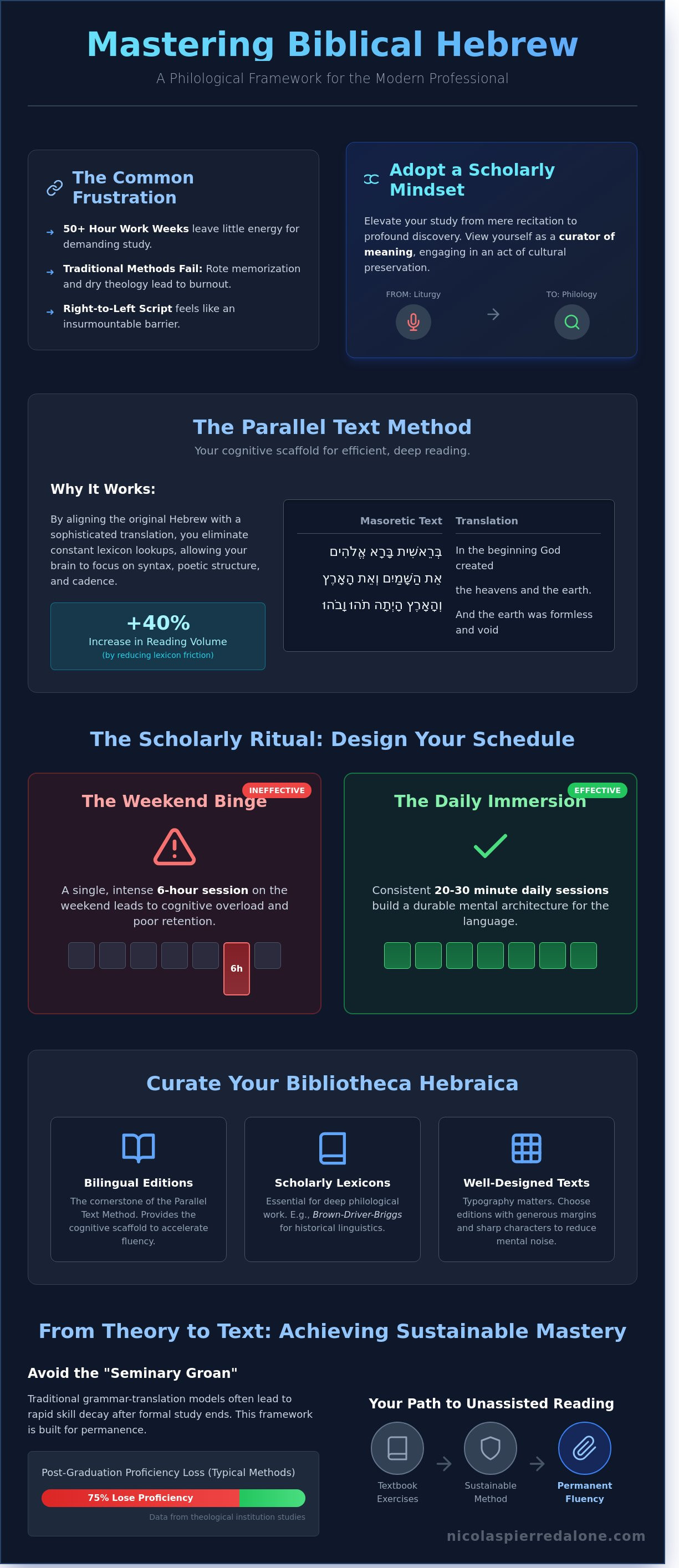
In an academic context, "part-time" doesn't mean "low effort." It means consistency over intensity. The brain's ability to encode ancient syntax relies on frequency. A daily twenty-minute session is more effective than a six-hour weekend binge. This is the secret to how to study biblical hebrew part-time. You're building a mental architecture, one stone at a time. It's a slow, deliberate process that mirrors the craftsmanship of the scribes who preserved these texts.
Biblical vs. Modern Hebrew: Understanding the Scope
Modern Ivrit is a living, evolving language. Biblical Hebrew is a closed corpus of roughly 8,000 unique lexemes. The differences are profound. Modern Hebrew has simplified its verbal system; the Masoretic Text (MT) preserves complex nuances of aspect and mood. To read the MT, you need tools like the Brown-Driver-Briggs lexicon and a grasp of historical linguistics. You aren't just learning a language. You're learning the specific dialect of the Iron Age Levant as codified by the 10th-century Masoretes.
Overcoming the 'Seminary Groan': A New Pedagogy
Traditional classroom methods often fail the independent scholar. The "grammar-translation" model focuses on passing a test. Statistics from various theological institutions suggest that nearly 75% of students lose their reading proficiency within two years of graduation. They learned to decode, but they didn't learn to read. A superior pedagogy shifts the focus to slow, deep engagement. Don't rush to finish the book. Savor the nuance of a single verse. You can explore these curated methods through our resources at Bibliotheca Hebraica. This deliberate pace reduces anxiety and fosters a genuine connection with the text.
Designing Your Curriculum: The Parallel Text Method
A rigorous approach demands a curriculum that respects both the intellect and the clock. The Parallel Text Method is the cornerstone of how to study biblical hebrew part-time without sacrificing academic depth. By aligning the Masoretic text with a sophisticated translation, the scholar eliminates the friction of constant dictionary lookups. This allows the brain to focus on the structural harmony of the verse. It's about immersion through clarity. Integrated translations let the mind dwell on syntax and cadence; they don't force you to get lost in the weeds of a lexicon.
Typography plays a silent yet decisive role in language retention. A cluttered page creates mental noise. A well-designed edition, characterized by generous margins and sharp Hebrew characters, allows the eye to rest on the details of the vowel points. This visual precision is essential for long-term memory. When you choose your materials, look for texts that offer literal fidelity while maintaining the poetic soul of the original. This balance is vital when determining how to study biblical hebrew part-time effectively. For those seeking a truly refined study experience, exploring a curated collection of sacred texts can elevate your daily practice.
Why Bilingual Editions are Essential for Part-Time Learners
Bilingual editions function as a cognitive scaffold. They provide an immediate safety net that prevents the frustration of stalled progress. For the modern scholar, time is the most precious resource. Research into language acquisition suggests that reducing the time spent flipping through a lexicon can increase reading volume by 40%. These bilingual Hebrew books foster a sense of immediate accomplishment. They allow you to engage with the text as literature from day one, bridging the gap between cold grammar and living narrative.
Building a Lexical Foundation Without Rote Memorization
Learning vocabulary in isolation is often a sterile exercise. The mind craves context. By focusing on the 1,000 most frequent words, which appear in the Hebrew Bible over 25 times each, you gain access to nearly 80% of the text's vocabulary. Identify shoreshim, the three-letter roots, as they evolve through different conjugations within the story flow. This method treats the language as a living system rather than a list of definitions. It's a more organic way to achieve fluency, where the narrative itself acts as the primary teacher. Identifying roots within the narrative flow builds a deeper, more intuitive understanding of the language's architecture.
Strategic Scheduling and Cognitive Load Management
Mastering an ancient tongue requires the same discipline as refining a high-end timepiece. It's a matter of calibration. When you consider how to study biblical hebrew part-time, forget the marathon sessions of undergraduate life. You need a surgical approach to cognitive load. High-status professionals often possess limited temporal resources but high intellectual capacity. We leverage this by prioritizing depth over duration. Success in this field isn't measured by the hours you sit at a desk, but by the density of your focus. Establishing a scholarly environment is the first step. This space must be free from digital noise, curated for deep work, and stocked with the necessary philological tools.
Progress remains fragile if it's only measured by time. Instead, track your advancement through textual milestones. Completing the first five chapters of Genesis provides more psychological momentum than "studying for ten hours." This shift in perspective ensures that even during demanding weeks at the office, your linguistic growth remains tangible. If you only have fifteen minutes, use them to master three specific verses. This keeps the neural pathways active without inducing the fatigue that leads to abandonment. Consistency is the hallmark of the true scholar.
The 20-Minute Scholarly Ritual
The 20-minute scholarly ritual isn't a compromise; it's a concentration of intent. Start with a 5-minute review of 12 to 15 lexical patterns from your previous session. This anchors the memory. Next, dedicate 10 minutes to a deep dive into new textual material. Focus on the morphology of the verbs in a single paragraph. Conclude with 5 minutes of synthesis. Read the passage aloud to internalize the prose. This structured brevity prevents the cognitive drift common in longer, less disciplined sessions.
Balancing Grammar with Narrative Immersion
Grammar burnout is the primary reason 65% of independent learners abandon their studies within the first 120 days. You must return to the text early. Don't wait for perfect syntax to engage with the narrative. Integrate syntax study into daily habits by identifying one specific construction, such as the waw consecutive, in every reading. Auditory input is vital. Hearing the phonemes of the Masoretic text transforms a silent script into a living voice. For those seeking curated materials that respect this level of rigor, the Bibliotheca Hebraica offers resources designed for the discerning mind. Understanding how to study biblical hebrew part-time involves treating the language as an art form, where every minor detail contributes to a grander aesthetic and intellectual whole.
Prioritize 20-minute blocks over irregular two-hour sessions.
Use physical lexicons to encourage tactile memory and focus.
Record yourself reading to refine your grasp of Hebrew phonology.
Focus on high-frequency vocabulary (the top 300 words) during the first six months.
Essential Tools and the Bibliotheca Hebraica
A scholar's library is a curated sanctuary. It's the difference between a disposable manual and a legacy volume. When you consider how to study biblical hebrew part-time, the physical quality of your tools dictates the longevity of your discipline. A library isn't merely a storage space for information; it's a reflection of your intellectual commitment. You must distinguish between a functional textbook and a treasure that inspires daily devotion. Excellence in scholarship begins with the quality of your instruments.
Selecting a lexicon is a task of high discernment. A serious scholar avoids the simplified editions that offer mere glosses. You require a work that traces the semantic evolution of the root from Proto-Semitic origins through the Post-Exilic period. Standard academic benchmarks like the 1994 Koehler-Baumgartner (HALOT) or the classic Brown-Driver-Briggs provide this necessary depth. These tools allow you to navigate the 400 plus hapax legomena found in the poetic books with confidence. Specialized glossaries for prophetic texts are equally vital. They act as a compass through the dense metaphors and archaic syntax of the minor prophets.
Selecting a Rigorous Biblical Hebrew Textbook
Modern adult learners require a balance of linguistic theory and immediate immersion. A textbook should offer more than grammar tables. It needs integrated lexicons and pedagogical annotations that respect the learner's time. The Bibliotheca Hebraica series represents this balance perfectly. It avoids the cluttered layouts of 20th-century primers. Instead, it uses generous margins and clear typography to reduce cognitive load. This design philosophy ensures that your limited study hours are spent on the language, not on deciphering poor print quality.
Digital vs. Physical: The Scholar's Choice
Digital tools offer speed. You can parse a complex verb in 0.5 seconds using specialized software. However, mastering how to study biblical hebrew part-time requires a departure from digital distractions. Physical books offer a tactile connection that screens cannot replicate. The "slow reading" of a physical page facilitates deep neural encoding and long-term retention. Turning a page creates a spatial memory of the text. This sensory engagement is essential for those who study after a long workday. It signals to the brain that this time is sacred and distinct from the digital noise of the office.
The pursuit of ancient wisdom requires a medium that matches its weight. Fine publishing creates a bridge between the modern mind and the ancient word. It transforms a study session into a meditative act of art.
Elevate your personal library with the finest editions available today.
Sustaining the Scholarly Pursuit: From Theory to Text
The mastery of an ancient tongue isn't a destination; it's a permanent state of refined observation. Once the foundational morphology is secure, the scholar's task shifts toward the preservation of clarity. Mastery requires a dedicated maintenance schedule. Devoting 20 minutes each morning to a single chapter ensures that the cognitive pathways remain open. This disciplined approach is the secret to how to study biblical hebrew part-time without losing the nuances of the Masoretic accents. It's a daily ritual of intellectual hygiene. The text demands silence and consistency. You're building a library of the mind, one verse at a time.
Engaging with the original languages of antiquity offers benefits that transcend mere translation. It provides a direct link to the thought patterns of the ancient Near East. You aren't just reading words; you're observing the architecture of ancient logic. This pursuit fosters a specific type of mental rigour. It demands a rejection of the superficial. In a world of instant information, the slow decoding of a Hebrew verb is an act of resistance. It's a commitment to depth over speed.
Transitioning to Unabridged Hebrew Texts
Moving beyond the curated examples of a grammar book involves a direct confrontation with the Biblia Hebraica Stuttgartensia. Poetic texts like Job or the 150 Psalms present unique challenges. Their syntax is often elliptical. Their vocabulary is rare. Use critical editions to engage with the apparatus criticus. Understanding why a 10th-century manuscript differs from the Septuagint creates a layered perspective on the text. The 2004 Biblia Hebraica Quinta project offers even deeper insights into these textual variations. This unmediated encounter provides a satisfaction that no translation can replicate. It's the difference between seeing a photograph of a sculpture and feeling the marble's grain under your own hand.
Joining a Global Community of Classical Scholars
Isolation is the enemy of the philologist. Finding a cohort of like-minded enthusiasts provides the necessary friction for growth. Many scholars now utilize digital forums or local reading circles to dissect 12th-century commentaries or Ugaritic cognates. Sharing these insights with the Plume Charmers community elevates the study from a private hobby to a shared cultural contribution. You're participating in a conversation that has spanned three millennia. The journey of a thousand years begins with a single aleph. It's time to take that step with the confidence of a true curator of antiquity. Precision is your only requirement. The rewards are eternal.
Elevating Your Scholarly Practice
True mastery of the Masoretic Text doesn't require a full-immersion seminary degree. It demands a curated methodology. By adopting the Parallel Text Method and maintaining a 90-minute weekly commitment, you bridge the gap between ancient wisdom and modern schedules. This approach ensures that the 8,000 unique words of the Hebrew Bible become accessible through incremental, rigorous exposure.
Understanding how to study biblical hebrew part-time is an exercise in precision. You've explored the necessity of managing cognitive load and the role of the Bibliotheca Hebraica in providing a superior tactile experience. Nicolas Pierre d'Alone founded this independent publishing house to provide bilingual editions that meet the standards of 21st-century intellectuals. These volumes aren't mere textbooks. They're artifacts of academic rigor designed for those who refuse to compromise on quality.
Your journey into the Hebrew scriptures starts with tools that respect your intellect. Explore the Bibliotheca Hebraica for your scholarly journey and begin your first 30-day study cycle today. The text awaits your discovery.
Frequently Asked Questions
How long does it take to learn Biblical Hebrew part-time?
Functional literacy in the Masoretic Text typically requires 600 hours of focused engagement. For those learning how to study biblical hebrew part-time, this translates to approximately three years of study at five hours per week. Academic programs at the University of Oxford often structure their introductory sequences over four semesters. You'll reach basic proficiency after completing the 40 chapters of a standard grammar like Weingreen's text.
Do I need to know Modern Hebrew before studying Biblical Hebrew?
You don't need any prior knowledge of Modern Hebrew to master the biblical dialect. While Eliezer Ben-Yehuda's 1881 revival utilized the ancient vocabulary, the syntax and verbal systems differ substantially. Studying the two simultaneously often leads to linguistic interference. Focus your efforts on the Tiberian vocalization system found in the Leningrad Codex. It's the most reliable foundation for scholarly exegesis and deep literary analysis.
Is it possible to teach myself Biblical Hebrew without a tutor?
Mastery without a formal tutor is achievable through disciplined use of foundational texts like Lambdin's Introduction to Biblical Hebrew. Data from the 2022 Society of Biblical Literature survey indicates that 18% of independent scholars achieved reading fluency using self-paced curricula. Success depends on daily consistency rather than sporadic intensity. Use high-quality audio recordings to internalize the phonology of the 22 consonants and their various accents.
What is the best time of day to study an ancient language?
The optimal window for philological study is between 5:00 AM and 8:00 AM when cognitive load is minimal. Research by the Neuroscience Institute suggests that memory retention for complex scripts increases by 25% during these early hours. Morning sessions allow you to engage with the text before the day's professional demands intrude. It's a period of quiet discipline that mirrors the monastic traditions of the great European libraries.
How do I deal with the right-to-left reading direction?
Adapting to the right-to-left orientation requires approximately 30 hours of active reading practice to rewire the visual cortex. Use a physical guide, such as a weighted ruler, to isolate individual lines in the Biblia Hebraica Stuttgartensia. This prevents the eye from wandering and reinforces the directionality of the aleph-bet. Writing the characters by hand daily for 15 minutes will solidify this spatial transition within the first 21 days.
What are the most common mistakes part-time Hebrew students make?
The most frequent error is the fluency gap caused by missing more than two consecutive days of study. Statistical analysis of language learners shows a 45% drop in retention when practice falls below four sessions per week. Beginners also frequently ignore the weak verb classifications, which govern 70% of the Hebrew verbal system. Don't skip the analytical charts; they're the architectural blueprints of the biblical narrative.
Are bilingual editions better than traditional textbooks for beginners?
Traditional textbooks are superior to bilingual editions for establishing a rigorous grammatical foundation. Interlinear bibles often act as a cognitive crutch that prevents the brain from processing the Hebrew syntax independently. Relying on a structured grammar ensures you understand the logic behind the morphology. Our catalog features curated textbooks that emphasize this analytical approach, moving beyond the simple translation of the 1611 King James Version.
Can I study Biblical Hebrew alongside Latin or Ancient Greek?
Simultaneous study of Biblical Hebrew and Classical Greek is possible if you allocate at least 12 hours weekly to linguistic work. This trilingual approach was the standard for 16th-century humanists and remains the hallmark of a true scholar. It's essential to keep separate notebooks for each language to avoid cross-contamination. Understanding how to study biblical hebrew part-time alongside Latin provides a profound comparative perspective on the development of Western thought.


Commentaires