%20-%20Copie.png)
How to Rekindle Your Passion for Ancient Greek: A Scholarly Roadmap for the Modern Intellectual
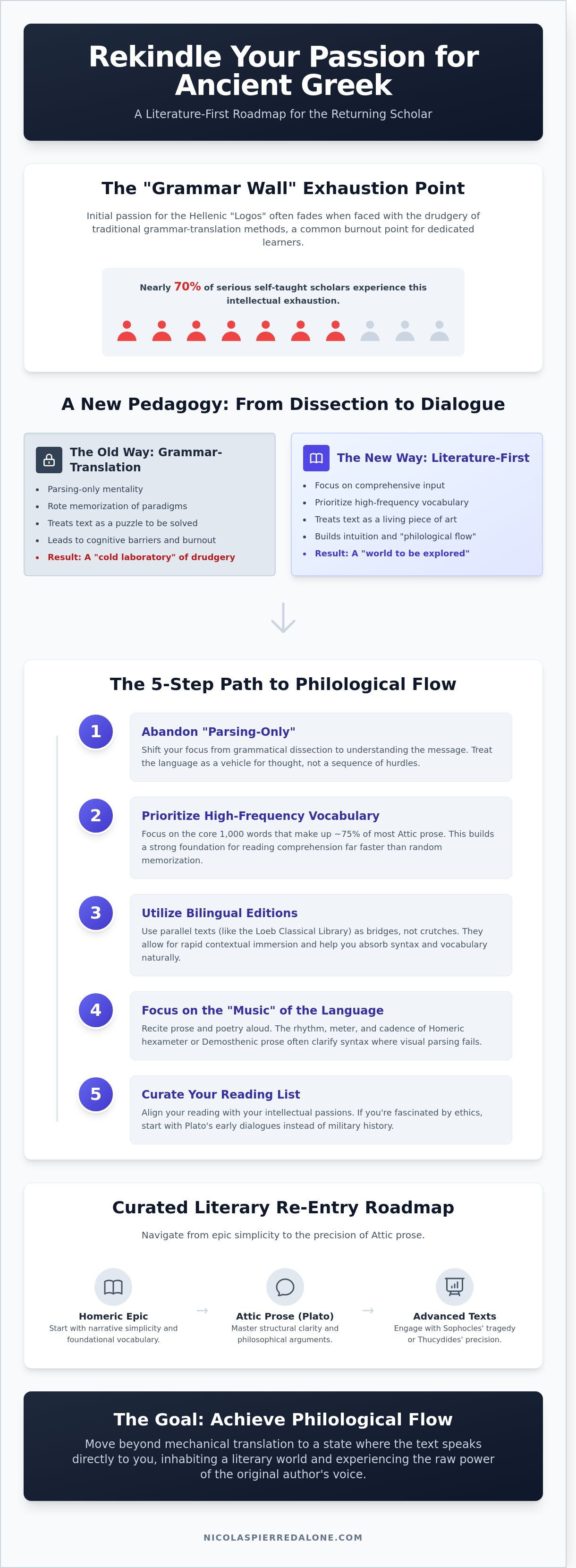
The belief that Ancient Greek is a dead language remains a pedagogical failure rather than a historical reality. You likely felt a profound intellectual spark when you first encountered the Homeric hexameter, yet that fire often dies behind the 1920 publication of Smyth’s grammar. It's a common exhaustion point that affects nearly 70% of serious self-taught scholars. This roadmap provides the methodology to rekindle your passion for ancient greek through a refined, literature-first approach to philological study.
You deserve an encounter with the classics that transcends the mechanical drudgery of the grammar wall and honors the aesthetic weight of the original text. You'll learn to move beyond the isolation of paradigms and toward a fluid, intuitive reading of Plato and Sophocles. We'll examine how high-quality, aesthetically designed reading materials and a sustainable study habit can transform your relationship with the Attic and Ionic dialects. This is a journey back to the source of Western thought, conducted with the rigor and elegance the material demands.
Key Takeaways
Reclaim the Hellenic "Logos" by moving beyond technical exhaustion toward a literature-first philological methodology.
Prioritize comprehensive input and high-frequency vocabulary to transcend the limitations of traditional grammar-heavy parsing.
Integrate bilingual editions and parallel text formats to rekindle your passion for ancient greek through seamless literary re-entry.
Navigate a curated roadmap starting with Homeric epic simplicity before mastering the structural clarity of Attic prose.
Design a sustainable scholarly practice using "Deep Work" principles and an environment tailored for classical contemplation.
Table of Contents The Intellectual Resonance of the Hellenic Tongue Transcending the Drudgery: A New Pedagogy for the Returning Scholar The Power of the Parallel Text Method Curating Your Re-entry: A Literary Roadmap Cultivating a Sustainable Scholarly Practice with Plume Charmers
The Intellectual Resonance of the Hellenic Tongue
Ancient Greek serves as the foundational architect of Western thought. It is the language of the Logos, providing the very structure through which reason and logic were first codified. For the modern intellectual, the decision to rekindle your passion for ancient greek often stems from a desire to access this primary source of heritage. The language isn't merely a tool for communication. It's a sophisticated system of thought that demands a specific type of mental discipline. However, many scholars find that their initial enthusiasm dissipates when the wonder of the text is replaced by the technical exhaustion of morphology and syntax. This transition marks the point where the language ceases to be a window and becomes a wall.
The goal of a true philological journey is to move beyond "learning a language" as a list of rules to be decoded. Instead, the objective is to inhabit a literary world. This requires achieving a state of "philological flow." In this state, the text speaks directly to the mind without the mediation of internal translation. It's a return to the raw power of the original voice, where the reader experiences the same intellectual urgency that moved the authors of the 5th century BCE.
The Philosophical Weight of Greek
Greek syntax shapes the capacity for nuanced inquiry in ways that modern English cannot replicate. The language allows for a precision of thought that is almost architectural in its stability. For a comprehensive overview of Ancient Greek and its dialectical richness, one must look at how the language handles contrast and balance. The beauty of particles like men and de provides a perfect example. These small, often untranslatable markers create a rhythmic symmetry, signaling to the reader exactly how two ideas relate to one another. Reconnecting with the specific authors who first inspired your journey, whether it was the epic sweep of Homer or the clinical precision of Thucydides, requires looking past the dictionary definitions to these subtle markers of logic.
Overcoming the "Grammar-First" Burnout
The traditional "grammar-translation" method often fails the adult learner because it prioritizes the autopsy of the sentence over the life of the narrative. Rote memorization of paradigms feels like a chore because it lacks an immediate aesthetic reward. To truly rekindle your passion for ancient greek, you must shift your focus toward reading for meaning and beauty. Our collection of Greek literary adaptations is designed to facilitate this shift, allowing the scholar to engage with the text as a living piece of art. Philological rekindling is a return to the aesthetic core of the language. When you stop treating the text as a puzzle to be solved, you begin to experience it as a world to be explored.
Transcending the Drudgery: A New Pedagogy for the Returning Scholar
Traditional instruction often treats Ancient Greek as a corpse to be dissected. The scholar's desk becomes a cold laboratory where syntax is measured with surgical precision but no soul. To rekindle your passion for ancient greek, you must abandon the 19th-century grammar-translation method. This archaic approach prioritizes the "parsing-only" mentality, which creates a cognitive barrier between the reader and the text. Real comprehension requires a shift toward comprehensive input. It's about moving from the mechanical to the meaningful.
Step 1: Abandon the "parsing-only" mentality. Treat the language as a vehicle for thought, not a sequence of grammatical hurdles. Focus on the message first.
Step 2: Prioritize high-frequency vocabulary. Zipf’s Law suggests that a small number of words account for the majority of any text. Focus on the core 1,000 words that make up roughly 75% of Attic prose.
Step 3: Utilize bilingual editions. Use the Loeb Classical Library or similar facing-page translations. These aren't crutches; they're bridges that allow for rapid contextual immersion.
Step 4: Focus on the "Music" of the language. Recite the hexameters of Homer or the prose of Demosthenes aloud. The rhythm often clarifies the syntax where the eyes fail.
Step 5: Curate your reading list. Match your texts to your current intellectual obsessions. If you're drawn to ethics, bypass the military history of Xenophon for the early dialogues of Plato.
The Shift from Decoding to Reading
Reading shouldn't involve stopping at every unknown particle. True fluency emerges when you allow your intuition to fill the gaps. Research from the 1970s into second language acquisition suggests that "extensive reading" is more effective than "intensive" decoding for long-term retention. You're building a mental lexicon through repetitive exposure to masterworks. The goal is to recognize the silhouette of a sentence before you analyze its components. It's a sophisticated form of pattern recognition that honors the author's intent. For those seeking curated materials that facilitate this transition, the Bibliotheca Graeca offers adaptations designed for modern intellectual engagement.
Integrating Modern Tools with Classical Rigor
Modernity offers tools that would've baffled the Renaissance humanists. Digital lexicons like Logeion provide instant access to the Great Scott (LSJ) without the physical weight. Use these tools to supplement your study, not replace it. Specialized glossaries for specific authors, such as those found in the Dickinson College Commentaries, reduce the friction of reading. Balance this ease with the rigor of discovery. The pleasure of finding the exact nuance of a Homeric epithet is a luxury that requires both digital speed and analog patience. This curated approach ensures that your pursuit remains an aesthetic experience rather than a chore.
The Power of the Parallel Text Method
Returning to Attic or Koine Greek after a long hiatus requires more than just a dusty lexicon. It demands a strategy that respects your time and intellectual maturity. Bilingual editions aren't a sign of weakness. They're a professional tool for the intermediate scholar. This method allows you to rekindle your passion for ancient greek by removing the barrier of constant dictionary lookups. You focus on the rhythm of the prose instead of the mechanics of the grammar. It's about moving from decryption to actual reading.
Format choice dictates your reading experience. Interlinear texts, while helpful for absolute beginners, often clutter the page and disrupt the visual flow of the Greek script. Parallel page formats, popularized by the Loeb Classical Library since 1912, offer a cleaner aesthetic. They allow the eye to drift right only when necessary. Integrated translations represent a more sophisticated approach. They treat the translation as a scholarly commentary, providing a mirror to the original text's nuances without sacrificing its artistic integrity. This layout respects the architectural beauty of the Greek sentence.
Scaffolding Your Comprehension
The English text serves as a structural scaffold. It's not a crutch; it's a verification system for complex syntax. When you encounter a particularly dense passage in Thucydides, the translation confirms your parsing of the dative cases. This reduces the cognitive load, a concept validated by educational psychologist John Sweller in 1988. Lower cognitive strain means you can sustain reading sessions for 60 minutes instead of burning out after 15. You build stamina through immersion, not just struggle. It's the difference between a chore and a craft.
Bibliotheca Graeca: A Standard for Bilingual Excellence
The Plume Charmers philosophy treats classical literature as a living heritage. Our Bibliotheca Graeca collection embodies this by providing integrated translations designed for deep philological work. These editions don't just provide a literal meaning. They offer specialized glossaries that track the evolution of specific terms across different genres. This level of detail transforms a standard reading session into a masterclass in linguistics. You aren't just reading a story. You're analyzing a piece of art. It's the most effective way to rekindle your passion for ancient greek while maintaining the rigor that a modern intellectual demands. Every page is a testament to the enduring power of the Hellenic mind.
Curating Your Re-entry: A Literary Roadmap
The path to linguistic recovery requires a deliberate selection of primary sources. To rekindle your passion for ancient greek, you must look beyond grammar tables and engage with the living word. Many scholars find that the "Epic" simplicity of Homer provides a more accessible entry point than the dense prose of the later orators. The Iliad, composed of 15,693 lines of dactylic hexameter, relies on a paratactic style. This structural clarity allows the reader to focus on the rhythmic pulse of the language without becoming lost in the labyrinthine subordinations of Attic legal oratory.
Xenophon’s Anabasis, written around 370 BC, serves as the traditional bridge for the returning student. Its vocabulary is remarkably consistent. The narrative follows a clear, linear progression that builds confidence. It's the gold standard for those who wish to master the clarity of Attic prose before attempting the more fragmented styles of the historians. Precision in selection is the mark of a disciplined mind.
From the Heroic Age to the Lyceum
Navigating the dactylic hexameter of the Iliad and Odyssey is an exercise in auditory memory. The formulaic nature of the epithets provides a resting place for the mind. Once the rhythm is internalized, the transition to Plato’s dialogues feels like a natural evolution. These texts represent the intersection where philosophy meets conversational Greek. They capture the vitality of Athenian intellectual life with a deceptive ease. You can explore these masterworks in our Ancient Greek Books: A Curated Guide to the Bibliotheca Graeca.
Selecting Your First "Return" Text
Criteria for your first text should prioritize syntactical transparency over mere thematic interest. A text with a vocabulary density that allows for 80% recognition on sight is ideal. The psychological benefit of finishing a shorter work, such as a single book of the Odyssey, cannot be overstated. I recommend "The Apology" as a quintessential re-entry point for its stylistic purity. It offers a profound encounter with the Socratic spirit through language that remains crisp and authoritative. It's a testament to the power of the unadorned word.
The challenge of the Tragedians requires a different level of philological stamina. Approaching Sophocles and Euripides involves grappling with choral odes that contain rare forms and complex metaphors. These works are best reserved for when your foundational fluency has stabilized. Conversely, Hellenistic and Koine Greek offer a different flavor for the biblical scholar. The New Testament texts, written between 50 and 100 AD, utilize a simplified syntax. They lack the nuanced optative mood of the classical era but possess a direct, evocative power that is essential for understanding the transition of the Greek world. To rekindle your passion for ancient greek is to recognize the unique texture of each era.
Discover the definitive collection for your scholarly journey. Explore the Bibliotheca Graeca today.
Cultivating a Sustainable Scholarly Practice with Plume Charmers
Philological mastery requires more than fleeting interest. It demands a ritual. To effectively rekindle your passion for ancient greek, you should adopt a "Deep Work" framework. Cognitive focus often peaks in 90-minute cycles. Dedicate these blocks to syntactical analysis or translation without digital interruption. Your environment must mirror this rigor. A dedicated desk, focused lighting, and the absence of screens create a sanctuary for classical contemplation. This physical boundary signals to the brain that the time for superficiality has ended.
Digital files lack the weight of history. The physical book is an anchor. Nicolas Pierre d’Alone’s editions, specifically those under the Plume Charmers imprint, are designed for this exact purpose. They don't just provide text. They offer an aesthetic experience that respects the intellectual weight of the content. These volumes serve as functional art. They ensure that your tools are as refined as your thoughts. A high-quality book sustains motivation through its tactile presence, reminding the scholar of the permanence of the Greek tradition.
The Aesthetic of the Study
The tactile sensation of premium paper and binding transforms study into a sensory ritual. Bilingual editions allow for a fluid movement between the original Greek and the translation. This layout reduces cognitive friction. Building a library isn't about storage. It's about curation. By selecting masterpieces from Plume Charmers, you bridge the gap between 5th-century BCE Athens and your modern study. These editions serve the modern academic aesthetic by prioritizing clarity, elegance, and durability.
Joining a Global Tradition of Philology
Ancient Greek isn't a destination you reach. It's a lifelong conversation with the foundations of Western thought. This pursuit places you within a lineage of scholars stretching back centuries. Consistency outweighs intensity. Ten minutes of daily reading often yields better long-term retention than sporadic five-hour sessions. The discipline of the daily page is what separates the enthusiast from the philologist.
If you're ready to commit to this path, visit the Plume Charmers homepage to find the resources necessary for your journey. To broaden your linguistic horizons and deepen your understanding of the classical world, explore the Bibliotheca Latina Antica for complementary studies. Your library is the physical manifestation of your intellectual legacy. It's time to build it with intention.
Returning to the Source: Your Path to Hellenic Mastery
True scholarship demands more than a casual glance at the past. It requires a structured return to the original syntax of Western thought. You've seen how the parallel text method bypasses the fatigue of traditional rote learning by placing the Greek text alongside precise English renderings. This approach ensures that your progress remains steady and your engagement remains deep. It's time to rekindle your passion for ancient greek through a curriculum that values your time and your intellect. Nicolas Pierre d’Alone provides the essential framework for this re-entry. These independently published volumes feature integrated translations designed for rigorous self-study and specialized glossaries that meet the highest academic standards. Each edition reflects a commitment to the artisan's touch in publishing. Your library is the foundation of your intellectual heritage. Build it with the care it deserves. The wisdom of the ancients is waiting for your return. Discover the Bibliotheca Graeca: Bilingual Editions for the Discerning Scholar. Begin your next chapter with the confidence that only true mastery provides.
Frequently Asked Questions
Is it possible to learn Ancient Greek on my own without a teacher?
You can certainly master Ancient Greek through disciplined autodidacticism. Many successful scholars use the 1978 JACT Reading Greek series or the Athenaze method to build a foundation. These texts provide the necessary scaffolding for the solo student. Success depends on consistent engagement with the primary materials rather than a reliance on external instruction. It's a journey of intellectual autonomy and precise, self-directed study.
How much time daily should I devote to rekindling my Greek skills?
Dedicate exactly 45 minutes each day to your studies to ensure optimal cognitive retention. Research from the 2014 Ebbinghaus retention studies suggests that daily exposure prevents the rapid decay of linguistic memory. Short, intense sessions are more effective than sporadic, five-hour marathons on weekends. This rhythm creates a sustainable habit that honors both your professional schedule and your intellectual ambitions.
Which dialect should I focus on: Attic, Homeric, or Koine?
Begin with the Attic dialect, as it serves as the grammatical baseline for 5th-century Athenian literature. Once you've mastered this foundation, transitioning to the Koine of the New Testament or the dactylic hexameter of Homer becomes a simple adjustment. Attic remains the gold standard for the serious philologist. It provides the most robust structural understanding of the language's evolution and its various literary forms.
Are bilingual books "cheating" for a serious student?
Bilingual editions, such as those in the Loeb Classical Library founded in 1912, are essential tools for contextual verification. They aren't a crutch; they're a map for navigating complex syntax. Use the English text only to confirm your parsing of difficult passages. This method allows you to maintain the narrative flow without losing the subtle nuances of the original Greek prose.
What is the best Ancient Greek lexicon for English speakers today?
The Liddell and Scott Greek-English Lexicon, specifically the 1996 Revised Supplement edition, remains the definitive resource for scholars. For a more portable experience, the 1889 "Middle Liddell" offers sufficient depth for 90% of classical texts. It's the silent partner in every serious scholar's library. These volumes provide the etymological depth required for a truly sophisticated understanding of the Greek vocabulary.
How can I improve my Ancient Greek vocabulary without rote flashcards?
To truly rekindle your passion for ancient greek, prioritize extensive reading of graded texts over the exhaustion of rote memorization. Studies indicate that encountering a word 15 times in different contexts leads to permanent acquisition. Analyze the etymological roots of 5 new words daily to build a sophisticated mental map. This approach transforms vocabulary building into an act of discovery rather than a chore of repetition.
What happens if I encounter a Greek sentence I simply cannot parse?
Consult Herbert Weir Smyth's 1920 Greek Grammar, which contains over 2,500 detailed sections on syntax and morphology. If the structure remains opaque, use digital treebanking tools to visualize the grammatical dependencies. Breaking the sentence into its constituent parts reveals the logic behind the most complex Attic prose. Every linguistic puzzle has a solution rooted in the rigorous rules of classical grammar.


Commentaires