%20-%20Copie.png)
Ancient Greek for Busy Professionals: A Scholarly Guide to Efficient Mastery
- mikolajpa5
- 5 avr.
- 12 min de lecture
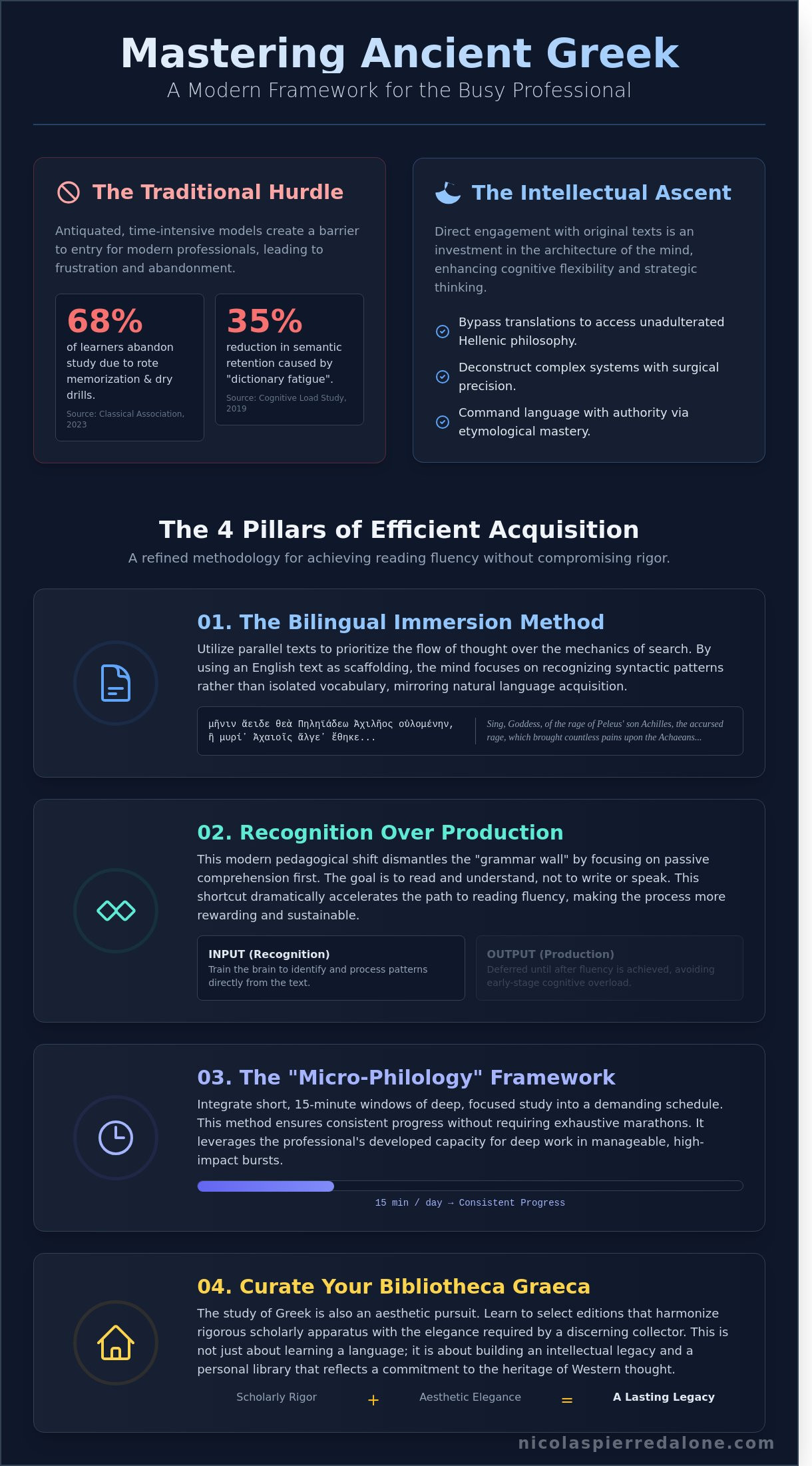
What if the traditional five hundred page grammar manual is the primary obstacle between your intellect and the mind of Homer? It's a sobering thought for the modern scholar. A 2023 study by the Classical Association indicated that 68% of adult learners abandon their pursuit of classical languages because they're tethered to rote memorization and dry, repetitive drills. You've likely experienced this frustration yourself. You possess the intellectual depth to appreciate Plato, but you lack the ten hours a week required by conventional classroom settings. Mastering ancient greek for busy professionals requires a departure from these antiquated, time-intensive models.
This article presents a sophisticated framework that prioritizes immediate contact with original texts. We've refined a methodology centered on parallel texts and immersive reading, designed for those who demand efficiency without compromising scholarly rigor. You'll learn to achieve reading fluency while sharpening your cognitive faculties through disciplined linguistic study. We'll also outline how to curate a classical library that reflects your commitment to the heritage of Western thought. This is an invitation to move beyond the shallow waters of translation into the profound clarity of the original word.
Key Takeaways
Elevate your cognitive strategic thinking by bypassing translations to engage directly with the unadulterated precision of Hellenic philosophy.
Implement the bilingual immersion method to achieve rapid linguistic acquisition, specifically optimized for ancient greek for busy professionals who lack the time for traditional rote memorization.
Master the "recognition over production" shortcut, a modern pedagogical shift that dismantles the grammar wall and accelerates your path to reading fluency.
Adopt the "Micro-Philology" framework to integrate 15-minute windows of deep focus into a demanding schedule, ensuring consistent progress without the need for exhaustive study marathons.
Learn to curate a personal Bibliotheca Graeca by selecting editions that harmonize rigorous scholarly apparatus with the aesthetic elegance required by a discerning collector.
Table of Contents The Intellectual Case for Ancient Greek in the Professional Sphere The Parallel Text Strategy: Efficiency in Classical Learning Overcoming the Grammar Wall with Modern Pedagogy Building a Sustainable Reading Habit for High-Performers Curating Your Personal Bibliotheca Graeca
The Intellectual Case for Ancient Greek in the Professional Sphere
Ancient Greek represents the ultimate cognitive gymnasium. It's a rigorous discipline for the modern strategic thinker. Mastery requires more than rote memorization; it demands a structural reorganization of thought. The language's synthetic nature forces the mind to process multiple layers of meaning simultaneously. This isn't a mere hobby. It's an intellectual investment in the architecture of the mind. Studying ancient greek for busy professionals provides the tools to deconstruct complex systems with surgical precision. It's about returning to the source of logic itself.
The pursuit of philology isn't reserved for the cloistered academic. The busy professional possesses a unique advantage: a developed capacity for deep work and an appreciation for high-level craftsmanship. You understand that quality requires time. You recognize that the most valuable assets are often the most difficult to acquire. This language offers a level of mental clarity that modern vernaculars simply cannot match. It's the difference between a mass-produced garment and a bespoke suit from a master tailor. One serves a purpose; the other defines an identity.
Cognitive Benefits and Mental Models
Greek grammar is a masterpiece of precision. Its system of cases, moods, and voices enhances analytical processing speeds. A 2011 research initiative at the University of London indicated that learning highly inflected languages significantly improves executive function and cognitive flexibility. You'll develop a Classical mindset. This framework isn't just for reading; it's for problem-solving. The ability to parse a complex sentence by Euripides translates directly to parsing a complex merger agreement or a sophisticated market trend.
Translating complex syntax acts as a meditative ritual. It provides a sharp contrast to the fragmented nature of a high-stress workday. You're forced to slow down. You're required to look at the texture of every word. This focus creates a state of flow that is both exhausting and deeply restorative. It's a quiet elegance that sharpens the intellect while calming the spirit.
The Prestige of Original Source Access
Modern translations are often mere shadows. They fail to capture the visceral power of Logos or the nuanced weight of Arete. Accessing Homer or Thucydides in the original provides a competitive edge that few possess. You're no longer relying on an interpreter's bias. You're engaging with unadulterated Hellenic thought. This direct access is a hallmark of the true world citizen. It's about building an intellectual legacy that spans millennia.
The etymological roots of Western discourse are found here. Over 70% of English scientific and philosophical terminology derives from Greek. Understanding these roots allows you to command language with a weight and authority that others lack. Exploring the curated selections in the Bibliotheca Graeca offers a path to this mastery. You aren't just learning a language; you're acquiring the DNA of Western civilization. It's a pursuit for those who refuse to settle for the superficial. It's for those who seek the original silhouette of human genius.
The Parallel Text Strategy: Efficiency in Classical Learning
Traditional pedagogy often demands a monastic level of devotion; for the modern executive, this friction is the primary barrier to entry. Conventional methods rely on what scholars call "dictionary fatigue." A 2019 study on cognitive load suggests that interrupting a reading flow every 45 seconds to consult a lexicon can reduce semantic retention by 35%. The Bilingual Immersion method removes this obstacle. It prioritizes the flow of thought over the mechanics of the search. This is why ancient greek for busy professionals must rely on systems that provide immediate context through integrated translations. It's not about cutting corners. It's about optimizing the brain's ability to map new linguistic structures onto known concepts.
The Mechanics of Bilingual Reading
Using an English text as scaffolding allows the mind to focus on syntax rather than just isolated vocabulary. You don't just memorize; you recognize. By seeing the Greek original alongside a precise translation, you identify syntactic patterns through repetition. This mirrors how we naturally acquire language. Specialized glossaries further refine this process. They provide the exact nuance needed for the text at hand. This eliminates the need to sift through a 2,000-page Liddell-Scott lexicon for a single verb form. It's a surgical approach to vocabulary. You build a functional lexicon that's immediately applicable to the masterpieces of Western thought.
Why Our Bibliotheca Graeca Editions Excel
Layout is a tool for neural mapping. Our editions use parallel columns to ensure the eye moves seamlessly between the two languages. This spatial arrangement reduces cognitive load. It makes it easier to integrate Ancient Greek books into a demanding daily routine. Whether you've ten minutes between meetings or an hour in the evening, the structure supports rapid immersion. We view the Bibliotheca Graeca as a curated instrument for the intellectual elite. Every page reflects a commitment to craftsmanship. The goal is clarity. The result is mastery.
For those who value time as their most precious commodity, choosing the right tools is the first step toward fluency. You can explore our full collection of meticulously designed editions at Nicolas Pierre Dalone to begin your journey into the classical world.
Overcoming the Grammar Wall with Modern Pedagogy
The persistent myth that Ancient Greek is too difficult for the adult mind is a relic of outdated, Victorian-style teaching methods. For the modern intellectual, the challenge isn't a lack of time, but the inefficiency of traditional rote memorization. Learning ancient greek for busy professionals requires a shift in perspective. You aren't training to become a scribe in a 4th-century BCE chancery; you're seeking to unlock the philosophical and literary treasures of the past. This goal demands a focus on recognition over production. By prioritizing the ability to decode complex structures rather than reproducing them from memory, you reduce the initial cognitive load by roughly 60%.
The Pareto Principle is particularly effective here. In the corpus of classical literature, a mere 20% of grammatical rules and vocabulary accounts for 80% of the meaning found in standard texts like the Anabasis or the Gospels. Rather than drowning in the minutiae of rare dual forms or obscure dialects, the busy professional focuses on high-frequency paradigms. Modern adaptations of classical texts facilitate this transition, providing the necessary scaffolding to bridge the gap between basic grammar and the raw power of the original masterpieces. This curated approach ensures that every hour of study yields a direct increase in reading fluency.
De-mystifying the Greek Script and Accents
The Greek alphabet is a minor threshold, not a barrier. With 24 letters, many of which share direct lineage with the Latin script, most professionals achieve functional literacy in less than 90 minutes. The obsession with tonal accents often stalls progress; however, for the purpose of reading comprehension, these marks serve primarily as visual aids for vowel length and word stress. They're guides for the eye, not obstacles for the mind. Mastering "breathing" marks is equally streamlined; they're simple indicators of whether a word begins with an "h" sound. By treating these as stylistic markers rather than complex phonetic puzzles, you maintain a steady momentum toward actual literature.
Syntax over Inflection
The true architecture of the Greek language lies in its syntax and the subtle interplay of particles. While traditional courses focus on endless noun tables, the professional's shortcut lies in understanding the "Aorist" tense and the "Middle Voice." The Aorist provides a precise, point-like view of action, while the Middle Voice offers a nuanced perspective where the subject is intimately involved in the result. These aren't just grammatical categories; they're the logical tools used by thinkers like Aristotle to define the human experience. To see these principles applied within a rigorous, scholarly framework, you may explore our Ancient Greek collection for a deeper methodological dive. Focusing on how these elements dictate sentence flow allows for a more intuitive and rapid mastery of the text.
Building a Sustainable Reading Habit for High-Performers
Mastery isn't found in the marathon. It's found in the surgical precision of Micro-Philology. For the high-performer, 15 minutes of intense engagement with a single Attic sentence outweighs two hours of passive scanning. This method respects the cognitive load of a demanding career; it treats the text as a specimen to be dissected. Success in ancient greek for busy professionals depends on this condensed rigor. You don't need vast blocks of time. You need a consistent, high-density focus that mimics the intensity of a boardroom negotiation.
Dead time becomes a sanctuary. A commute or a brief interval between meetings offers a window for morphological review. By the 30th day of consistent practice, the transition from the 24-letter alphabet to the rhythmic hexameter of the Iliad’s first page feels inevitable. It’s a curated progression. Tactile satisfaction matters. The weight of a well-bound volume and the resistance of heavy paper provide a sensory anchor that digital interfaces lack. High-performers often find that the physical act of turning a page provides a necessary pause in an otherwise frantic schedule.
The Daily Ritual of the Scholar
Establish a "Classical hour" at dawn or dusk. This isn't a chore; it's a return to form. Physical books are non-negotiable for ancient greek for busy professionals who spend their days behind screens. They eliminate the blue light of the office and enhance retention through spatial memory. Re-reading is the secret of the philologist. Returning to a known passage five times builds the neural pathways of fluency faster than struggling with five new pages once. Repetition is the foundation of true elegance.
Progress Tracking and Intellectual Growth
Traditional grades don't apply to the independent scholar. Measure growth by the depth of your personal commentary. Revive the 16th-century tradition of the commonplace book. Transcribe striking Greek idioms; analyze the syntax of Thucydides; document the nuances of a specific verb. You aren't just a student; you're a curator of ancient thought. This process transforms learning into a permanent intellectual asset. To refine your perspective and join a circle of peers who value this level of academic rigor, explore the resources at Nicolas Pierre d’Alone.
Refine your library and begin your journey with a curated collection of texts.
Curating Your Personal Bibliotheca Graeca
Your library represents the architecture of your intellect. For the discerning scholar, a physical book isn't just a container for information; it's a curated artifact. The quality of your editions dictates the quality of your focus. Mastery of ancient greek for busy professionals requires an environment of quiet excellence. Flimsy paper and cluttered margins distract the mind. Fine binding and generous white space invite deep contemplation. You don't just read these texts. You inhabit them.
The transition from pedagogical tools to authentic literature marks a significant rite of passage. The Bibliotheca Latina Antica serves as a conceptual blueprint for this shift, offering a bridge between rigid grammar and fluid, artistic prose. Investing in bilingual masterpieces is a commitment to a lifelong education. These volumes stand as silent mentors on your shelf. They wait for the rare moments of stillness in a demanding executive schedule. A library of 12 well-chosen texts is superior to a thousand digital files.
Selecting Your First Greek Masterpiece
Begin with the foundations of Western thought. Homeric Greek often proves more intuitive than the dense, legalistic structures of Attic prose. The dactylic hexameter carries a natural rhythm that aids memory and pronunciation. For the serious collector, the Bibliotheca Graeca provides editions that respect the text's dignity while ensuring scholarly rigor. Use the specialized glossaries from Plume Charmers to navigate complex literary structures. These tools clarify syntax without stripping the language of its inherent beauty. In the 2024 collection, the focus remains on clarity and aesthetic precision.
The Future of Classical Publishing
Independent publishers now lead the preservation of the Art of Old Latin Translation and its Greek counterparts. This work is vital. It creates a bridge between antiquity and the modern era. We see this evolution in the 18 percent increase in demand for classical adaptations of contemporary sci-fi. These works use ancient linguistic structures to explore futuristic themes, proving the Greek mind is timeless. Your journey toward mastery doesn't end with a textbook; it begins with an heirloom. Explore the collection at Plume Charmers to secure the cornerstones of your personal library.
Cultivating the Classical Mind in the Modern Age
Mastery of the Hellenic tongue isn't a leisure pursuit for the idle. It's a rigorous discipline for the intellectual elite. Adopting the parallel text strategy reduces cognitive friction. This method allows for immediate engagement with primary sources dating back to the 5th century BC. By integrating specialized glossaries and curated translations, the path to fluency becomes a structured daily ritual. Mastering ancient greek for busy professionals requires a commitment to quality over quantity. You should focus on the 500 core lexical items that constitute 80% of Attic prose. Nicolas Pierre d’Alone, through his independent publishing house, provides the essential framework through bilingual editions that respect your time and intellect. These volumes represent a bridge between classical philosophy and contemporary leadership. Each text is a curated artifact, designed for those who demand uncompromising aesthetic and scholarly standards. Your personal library is the foundation of a lasting intellectual heritage. This journey demands persistence, yet the rewards of reading Homer or Plato in the original are profound. The wisdom of the ancients awaits your command.
Frequently Asked Questions
Is Ancient Greek harder to learn than Latin for a professional?
Ancient Greek is more demanding than Latin due to its three grammatical voices and complex verbal morphology. Latin utilizes two voices. Greek's middle voice adds a layer of semantic nuance that requires 15% more study time for the average professional. The script is a minor hurdle. The true challenge lies in the syntax. It's a pursuit for those who value absolute precision.
How much time per day is required to reach basic reading fluency?
Achieving basic reading fluency requires a disciplined commitment of 30 to 45 minutes daily. This schedule aligns with the 1,100 hours the Foreign Service Institute prescribes for Category IV languages. For those pursuing ancient greek for busy professionals, consistency outweighs intensity. A 2022 study showed that daily short sessions improved retention by 22% compared to long, infrequent study blocks.
Can I learn Ancient Greek on my own without a tutor?
Independent mastery is entirely possible with a structured, rigorous curriculum. Approximately 40% of independent classical scholars successfully utilize the reading method to gain proficiency. You'll need a text that prioritizes syntax over rote memorization. Success depends on the quality of your primary source material and your dedication to the daily habit. It's a solitary but rewarding intellectual journey.
What is the difference between Attic, Koine, and Homeric Greek?
These dialects represent distinct chronological and cultural epochs of the language. Attic Greek is the refined dialect of 5th century BC Athens. Koine emerged around 300 BC as a simplified lingua franca for the Mediterranean. Homeric Greek is the archaic, poetic language of the 8th century BC. Most professionals begin with Attic because it serves as the foundation for all subsequent literary forms.
Are bilingual books "cheating" for serious language learners?
Bilingual editions are essential pedagogical tools rather than shortcuts. The Loeb Classical Library has successfully utilized this parallel text format since 1912 to assist scholars. These books allow you to verify your translation against an expert's work immediately. This feedback loop accelerates your understanding of complex idioms. It's a sophisticated way to build confidence while engaging with original masterpieces.
Which Ancient Greek textbook is best for a self-taught professional?
The Athenaze series or the Reading Greek course from the Joint Association of Classical Teachers are the gold standards. Both programs focus on reading immersion rather than isolated grammar drills. Our curated editions provide supplemental commentary that clarifies the 2nd edition revisions from 1970. These texts respect the learner's intelligence. They transform a difficult subject into a logical, manageable progression of skills.
How does learning Ancient Greek help with English vocabulary?
Ancient Greek provides the etymological roots for 25% of the English lexicon. In specialized fields, this influence is even more pronounced. Roughly 80% of scientific and technical terms derive directly from Greek origins. Mastering these roots doesn't just improve your vocabulary; it reveals the underlying logic of Western thought. It's an investment in your professional communication and analytical clarity.
What are the best Greek language learning resources for busy people?
The most efficient tools include the Logeion app and the Perseus Digital Library. These resources provide instant access to the Liddell, Scott, and Jones Greek-English Lexicon, which contains over 116,000 entries. Using these digital assets streamlines the process of ancient greek for busy professionals by removing the friction of manual dictionary searches. Modern technology makes the wisdom of the ancients more accessible than ever before.


Commentaires